
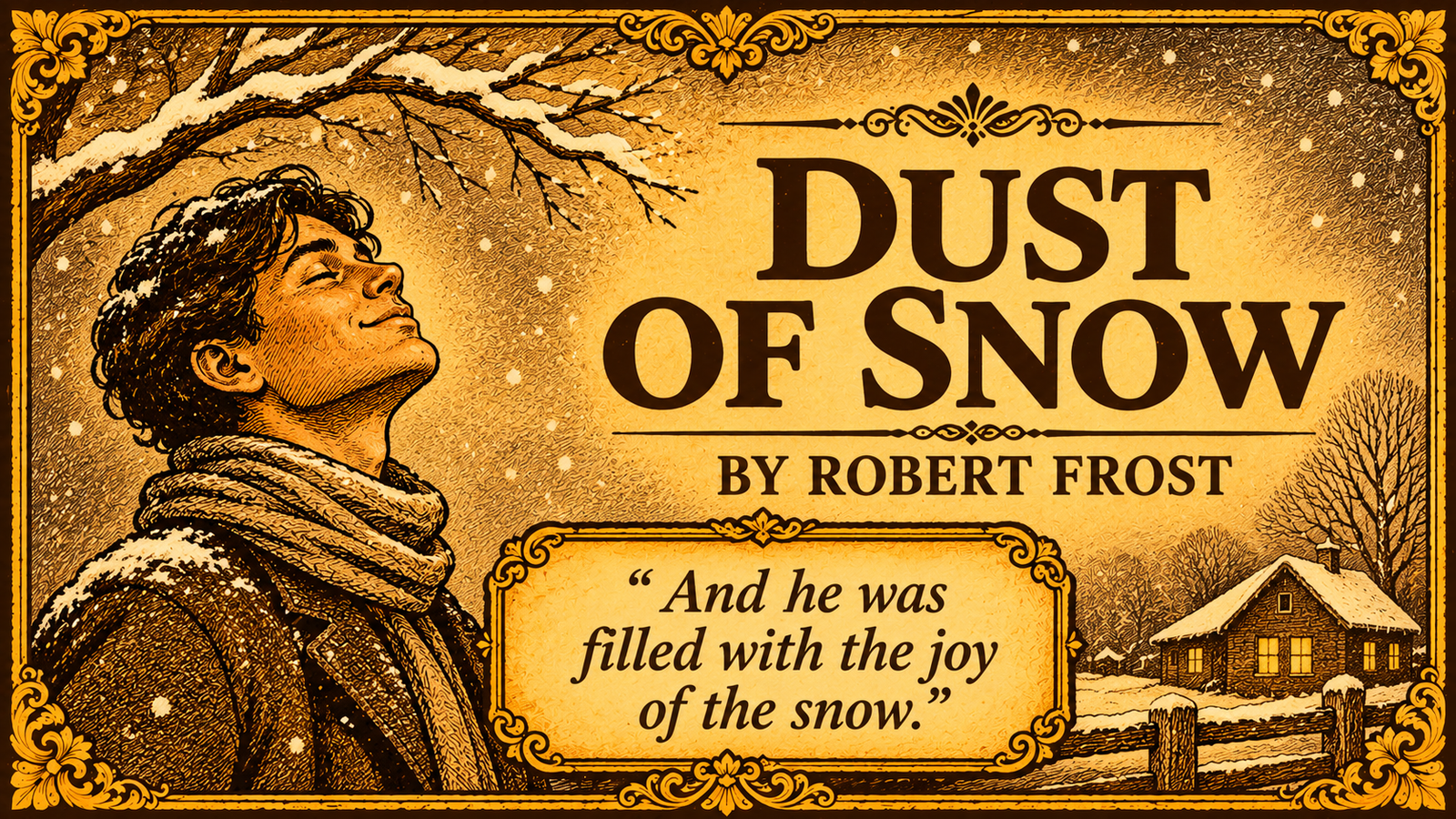
Dust of Snow is a brief poem depicting a speaker whose gloomy mood is unexpectedly transformed when a crow shakes a dusting of snow off a hemlock tree onto them, saving what remained of a regretful day
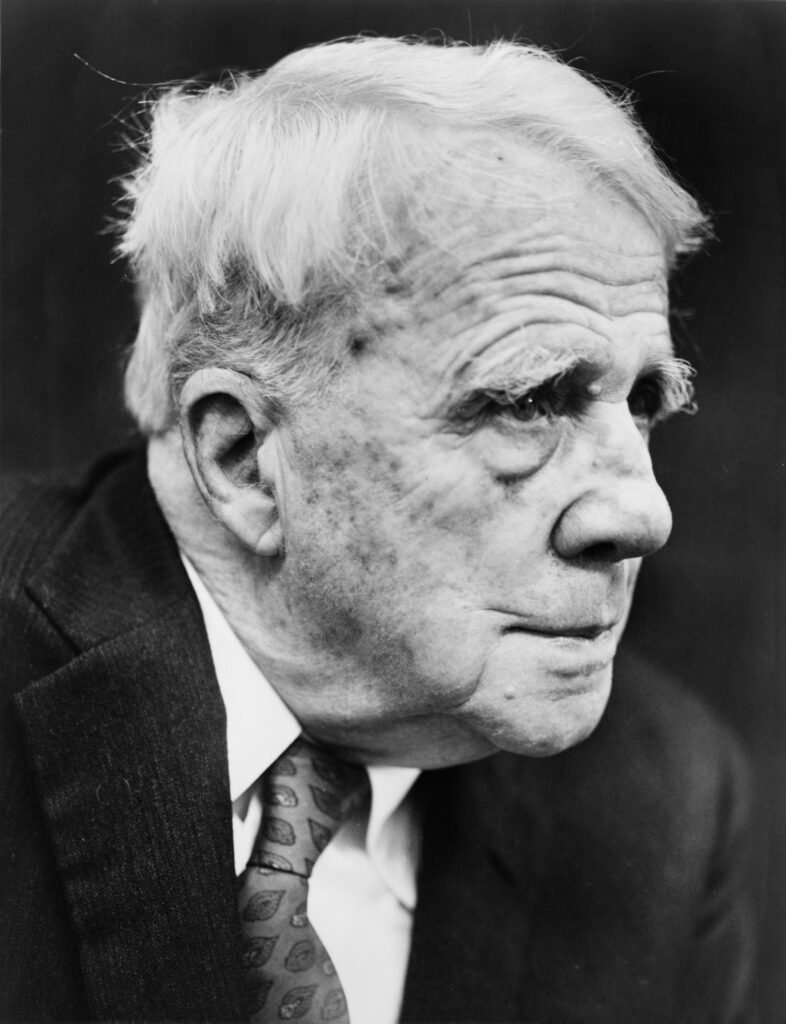
Robert Lee Frost (March 26, 1874 – January 29, 1963) was an American poet celebrated for his realistic depictions of rural New England life and his deep mastery of American colloquial speech.
Quick Facts
Major Honors: He is the only poet in history to win four Pulitzer Prizes for Poetry (A Further Range, New Hampshire, A Witness Tree, and Collected Poems). He also recited his poem “The Gift Outright” at the inauguration of President John F. Kennedy in 1961.
Birth & Death: Born in San Francisco, California, and moved to New England as a boy after his father’s death; died in Boston, Massachusetts.
Literary Style: Blended traditional verse forms with conversational rhythms and everyday language to explore complex human, social, and philosophical themes.
Famous Works:
“The Road Not Taken”
“Stopping by Woods on a Snowy Evening”
“Mending Wall”
“Fire and Ice”
He is the only poet in history to win four Pulitzer Prizes for Poetry (A Further Range, New Hampshire, A Witness Tree, and Collected Poems). He also recited his poem “The Gift Outright” at the inauguration of President John F. Kennedy in 1961.
Summary:
- The Event: While the speaker is outdoors, a crow sitting in a hemlock tree shakes a dusting of snow down onto them.
- The Impact: This simple interaction with nature brings about a “change of mood” in the speaker’s heart, saving a portion of a day that had previously been ruined or regretted (“rued”).
Explanation, Meanings and Annotations:
Line by line meanings:
- “The way a crow”: Refers to the movement or action of a crow.
- “Shook down on me”: Describes the bird shaking something off the tree branch onto the speaker below.
- “The dust of snow”: Identifies the falling material as fine particles or a dusting of snow.
- “From a hemlock tree”: Specifies that the snow fell from a hemlock tree.
- “Has given my heart”: Indicates an internal, emotional impact on the speaker.
- “A change of mood”: States that the event altered the speaker’s emotional state.
- “And saved some part”: Explains that the incident rescued a portion of time.
- “Of a day I had rued.”: Clarifies that the preserved time was part of a day the speaker had previously regretted or felt sorrow about.
Important Word Meanings:
- Hemlock – Appears in the line “From a hemlock tree”.
- Rued – Appears in the line “Of a day I had rued”.
Literary and Poetic Devices:
Symbolism & Unconventional Imagery:
Frost employs traditionally negative symbols—a crow (associated with dark omens) and a poisonous hemlock tree—and turns them into unexpected catalysts for joy, purity, and renewal (represented by the “dust of snow”).
Rhyme Scheme & Enjambment:
Follows a regular ABAB CDCD rhyme scheme (crow/snow, me/tree, heart/part, mood/rued). It uses Enjambment throughout the entire poem, as a single continuous sentence flows across line breaks without terminal punctuation until the final line.
Alliteration: Repetition of initial consonant sounds:
- “ H as given my h eart” (/h/ sound).
- “ s aved s ome part” (/s/ sound).
Assonance: Repetition of vowel sounds, such as the prominent /o/ sound in “Sh oo k d ow n o *n me”*.
Literary & Figurative Devices:
Unconventional Symbolism:
- Crow and Hemlock Tree: Typically associated with gloom, poison, or bad omens, but Frost subverts this expectation by making them agents of positive change.
- Dust of Snow: Symbolizes small, unexpected moments in nature that bring emotional healing.
Synecdoche: The phrase “given my heart “ uses a part of the body to represent the speaker’s entire emotional state.
Metaphor: The physical falling of snow acts as a metaphor for a sudden, refreshing spark of emotional transformation.
Inner Meaning of the poem:
- The poem conveys how small, unexpected encounters with nature can bring about emotional healing and renewal.
- The speaker begins in a state of gloom, regretting or sorrowing over their day (“a day I had rued”).
- When a crow shakes fine snow down from a hemlock tree onto the speaker, this simple moment in nature alters their internal state (“Has given my heart / A change of mood”).
- The core message is that nature has the power to break a cycle of negative thoughts, saving a portion of time that seemed otherwise lost or wasted.
Textual Exercise Answers
1. What is a “dust of snow”? What does the poet say has changed his mood? How has the poet’s mood changed?
Answer:
- Dust of Snow: It refers to the fine particles of snow that fell from the tree.
- Cause of Mood Change: A crow shook the snow from a hemlock tree, and it fell on the poet.
- Change in Mood: The poet’s mood changed from sadness to happiness. This small incident refreshed his mind and saved the rest of his day from being wasted.
2. How does Frost present nature in this poem? The following questions may help you to think of an answer.
(i) What are the birds that are usually named in poems? Do you think a crow is often mentioned in poems? What images come to your mind when you think of a crow?
Answer:
Poets usually mention beautiful and melodious birds like nightingales, larks and cuckoos in their poems. A crow is not commonly mentioned because it is generally associated with its harsh voice, black colour and bad omens. It usually creates images of darkness and sadness.
(ii) Again, what is “a hemlock tree”? Why doesn’t the poet write about a more ‘beautiful’ tree such as a maple, or an oak, or a pine?
Answer:
A hemlock is a poisonous tree. The poet chooses this tree instead of a more beautiful one to show that even things associated with negativity can bring happiness. Through this choice, Frost suggests that nature can refresh our minds and change our mood in unexpected ways.
(iii) What do the ‘crow’ and ‘hemlock’ represent — joy or sorrow? What does the dust of snow that the crow shakes off a hemlock tree stand for?
Answer:
The crow and the hemlock tree represent sorrow, sadness and negativity. On the other hand, the dust of snow represents joy, hope and freshness. Its sudden fall on the poet changes his mood and makes him feel better.
3. Have there been times when you felt depressed or hopeless? Have you experienced a similar moment that changed your mood that day?
Answer:
Yes, there have been times when I have felt sad and hopeless. Once, while I was feeling low, I went outside and enjoyed the cool breeze and the beauty of nature. It refreshed my mind and made me feel happy. Like the poet, I realised that even a small incident can bring a positive change in our mood.
EXPLANATION VIDEO – COMING SOON



Leave a Reply