
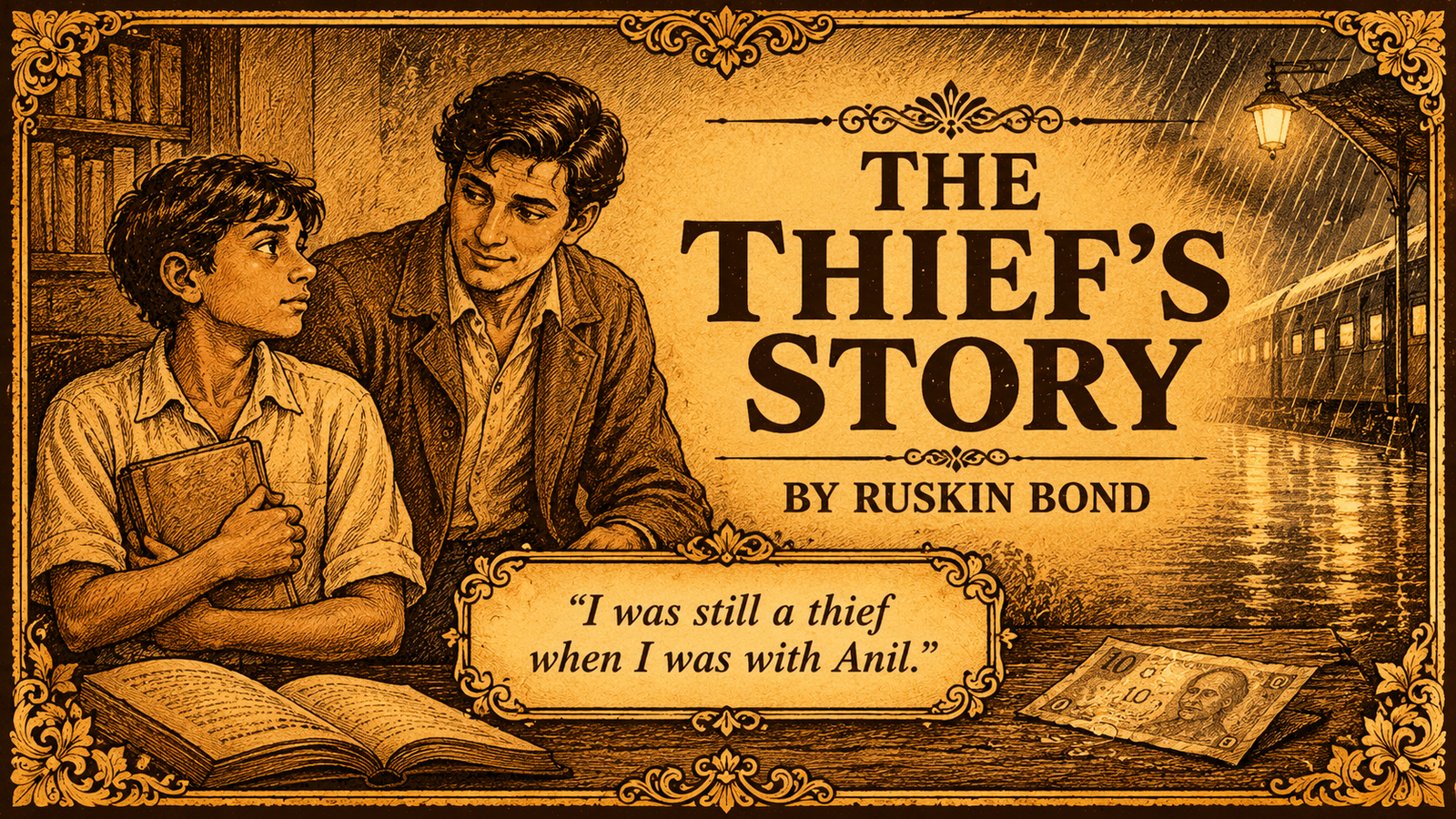
In “The Thief’s Story” by Ruskin Bond, a fifteen-year-old experienced criminal named Hari Singh befriends a kind and trusting writer named Anil to find an opportunity for theft. After gaining Anil’s confidence and moving into his home, Hari steals a large sum of money and runs to the railway station, but he hesitates and misses his train. Standing alone in the cold rain, the young thief reflects on the value of education that Anil promised to teach him and ultimately decides to return the stolen cash. When morning arrives, Anil hands him a wage and reveals that he knows about the incident, yet chooses to forgive him silently while offering genuine friendship and a fresh start.

Ruskin Bond (born May 19, 1934) is a celebrated Indian author and poet of British descent, widely known as the “Writer of the Hills.”
Quick Facts
- Birth: Born in Kasauli, Himachal Pradesh, British India.
- Childhood: Spent his early years in Jamnagar, Dehradun, and Shimla, attending Bishop Cotton School.
- Home: He has lived for most of his life in Landour and Mussoorie in the Indian Himalayas, which heavily inspire his work.
- Debut: He wrote his first novel, The Room on the Roof, at age 17, which won the John Llewellyn Rhys Prize in 1957.
- Body of Work: He has authored over 500 short stories, essays, and novels, including more than 60 children’s books.
- Themes: His writing focuses on simple village and small-town life, nature, mountains, childhood, and human relationships, characterized by clear, warm, and accessible prose.
- Famous Adaptations: Works like A Flight of Pigeons (adapted into the film Junoon), The Blue Umbrella, and Susanna’s Seven Husbands (adapted into 7 Khoon Maaf) have been brought to the screen.
Sahitya Akademi Fellowship (2021)
Sahitya Akademi Award (1992) for Our Trees Still Grow in Dehra
Padma Shri (1999)
Bal Sahitya Puraskar (2012)
Padma Bhushan (2014)
Summary:
1. First Meeting and Misleading Introductions
The narrator, a 15-year-old experienced thief, approaches a 25-year-old easy-going man named Anil during a wrestling match. Hoping to gain his trust and find a new target, the boy flatters Anil by saying he looks like a wrestler himself. When asked his name, the boy lies and introduces himself as “Hari Singh”—a fake name he changes monthly to evade the police and past employers.
2. Employment and the Terrible Meal
Hari follows Anil after the match and asks to work for him. Anil explains that he cannot afford to pay wages, so Hari asks if Anil can at least feed him. When Hari lies again by claiming he can cook, Anil agrees to take him in and brings him to his room located above the Jumna Sweet Shop. However, the dinner Hari prepares that night is so awful that Anil feeds it to a stray dog and tells Hari to leave. Hari responds with an appealing smile, causing Anil to laugh and relent, promising to teach him how to cook.
3. Education and Daily Routines
Anil begins teaching Hari how to write his name and promises to teach him how to write full sentences and add numbers. Hari feels deeply grateful, recognizing that literacy would unlock limitless future opportunities for him. Hari’s daily routine involves preparing morning tea and purchasing the day’s supplies. While shopping, Hari secretly retains a small profit of about one rupee a day—a practice Anil seems to notice but chooses to ignore.
4. Anil’s Livelihood and the Temptation
Anil earns a living irregularly by writing for magazines, borrowing money one week and lending the next. One evening, after selling a book to a publisher, Anil returns home with a bundle of notes amounting to 600 rupees in fifty-rupee notes and tucks them under his mattress. Having worked for Anil for nearly a month with complete freedom and a key to the room, Hari feels tempted to rob him. Hari rationalizes the theft by telling himself that Anil is careless, would likely waste the money on friends, and does not pay him a regular wage.
5. Executing the Theft
That night, while Anil sleeps peacefully in the moonlight, Hari creeps over to the bed. He quietly slides his hand under the mattress and draws out the cash without making a sound. Although startled when Anil sighs and turns toward him in his sleep, Hari quickly crawls out of the room and escapes onto the road.
6. Hesitation at the Railway Station
Hari runs down the road with the 600 rupees tied around his waist by his pajama string. He makes his way to the station to catch the 10:30 Express to Lucknow. As the train moves slowly out of the station, Hari has ample opportunity to jump into one of the carriages, but he hesitates for an unexplainable reason and lets the train depart without him.
7. Internal Reflection in the Rain
Left alone on the deserted platform, Hari walks through the bazaar and reflects on how different people react to losing their belongings—greedy men show fear, rich men show anger, and poor men show acceptance. However, he realizes that when Anil discovers the theft, his face will only display sadness over the loss of trust rather than the loss of money. A chilly November drizzle begins, leading to heavy rain that drench Hari’s clothes and dampens the stolen money tucked at his waist. Sitting under a clock tower in the bazaar, Hari inspects the wet notes.
8. The Decision to Return
Hari realizes that while stealing is easy, obtaining an education and becoming a respected, clever man offers far greater value than a few hundred rupees. Driven by his desire to learn how to read and write, Hari decides to return to Anil. Nervous that returning stolen money undetected is harder than taking it, he quietly creeps back into the dark room and slips the wet notes back under Anil’s mattress.
9. Silent Forgiveness and Transformation
The next morning, Hari wakes up late to find that Anil has already prepared tea. Anil hands Hari a wet fifty-rupee note, explaining that he earned money the day before and will now pay Hari regularly, adding that they will begin writing sentences that day. Sensing the dampness of the note, Hari understands that Anil knows about the theft, yet Anil says nothing and shows no anger. Touched by Anil’s quiet mercy and acceptance, Hari smiles at Anil—a genuine smile that comes naturally from within.
Word Meanings and Annotations:
- Fairly successful hand: Skilled, proficient, or experienced at a particular work (here, stealing).
- Lean: Thin, slender, and healthy in appearance.
- Easy-going: Relaxed, calm, and open-minded.
- Get into one’s confidence: Win someone’s trust or faith.
- Flattery: Insincere or excessive praise used to gain someone’s favor.
- Modestly: In a humble manner without boasting.
- Former: Previous or earlier (referring to past employers).
- Grunting: Making low, rough guttural sounds while exerting physical effort.
- Casually: In a relaxed, informal, or unconcerned way.
- Appealing: Attractive, charming, or engaging.
- Misjudged: Formed a wrong opinion or incorrect estimate about someone.
- Balcony: An outdoor elevated platform attached to the upper floor of a building.
- Terrible: Extremely bad, unpleasant, or poor in quality.
- Stray: An animal that has wandered away from home or has no owner.
- Hung around: Lingered or stayed nearby without a specific purpose.
- Patted: Tapped gently with an open hand as a gesture of affection or approval.
- Grateful: Feeling or showing appreciation for kindness received; thankful.
- Achieve: Successfully reach a goal or accomplish something through effort.
- Supplies: Necessary daily items and provisions, such as groceries.
- Profit: Financial gain made from buying or selling something.
- By fits and starts: Irregularly; in short, spasmodic bursts rather than continuously.
- Queer: Strange, odd, or unusual.
- Publisher: A person or company that prints and distributes books or magazines.
- Tuck: Push or fold securely into a hidden or narrow space.
- Mattress: A large fabric pad used on a bed for sleeping.
- Greedy: Excessively eager to acquire wealth or possessions.
- Careless: Not paying sufficient attention to avoid loss or harm.
- Out of practice: Lacking current skill due to a temporary pause in performing an activity.
- Beam: a ray or stream of light.
- Crept: Moved slowly and quietly close to the ground to avoid detection.
- Unlined: Smooth; showing no wrinkles or signs of worry and stress.
- Scars: Marks remaining on the skin after a wound or injury has healed.
- Sighed: Emitted a deep, audible breath expressing relief, fatigue, or tiredness.
- Startled: Feeling sudden alarm, surprise, or shock.
- Dashed: Ran quickly with great speed and urgency.
- Carriages: Separate passenger cars of a railway train.
- Hesitated: Paused briefly before acting due to uncertainty or doubt.
- Deserted: Empty of people; abandoned.
- Curious: Inquisitive; eager to know or learn more about something.
- Bazaar: A market street lined with shops.
- Career: A profession or occupation pursued over a period of time.
- Acceptance: Quiet resignation or willingness to tolerate a difficult situation.
- Maidan: An open grassy field or public park.
- Chilly: Uncomfortably cold.
- Drizzle: Light, fine rain falling in tiny drops.
- Discomfort: A state of physical or mental unease.
- Shelter: A covered structure providing protection from bad weather.
- Damp: Slightly wet or moist.
- Respected: Admired and held in high regard by others.
- Undetected: Without being seen, heard, or noticed.
- Heart sank: Felt a sudden loss of hope, courage, or confidence.
- Discovered: Caught, exposed, or found out.
- Spirits rose: Became hopeful, happy, or cheerful again.
Think about it:
1: What are Hari Singh’s reactions to the prospect of receiving an education? Do they change over time? What makes him return to Anil?
Answer:
- Initial Reaction: At first, Hari Singh views education as a practical tool to enhance his abilities and expand his opportunities as a thief. When Anil promises to teach him how to write his name, write full sentences, and add numbers, Hari feels deeply grateful, believing that once he can write like an educated man, there will be no limit to what he can achieve.
- Transformation Over Time: Over time, Hari’s perspective undergoes a profound change. After stealing the 600 rupees and missing the train, he sits alone in the rain and reflects on his actions. He realizes that stealing money is easy and getting caught is just as simple, but becoming a “really big man, a clever and respected man” requires genuine education. The value of literacy shifts in his mind from a tool for clever theft to a gateway for earning self-respect and living an honorable life.
- Reason for Returning: Hari returns to Anil primarily out of a strong desire to learn to read and write. He also feels guilty about betraying the trust of the only person who treated him with unconditional kindness and respect.
2: Why does not Anil hand the thief over to the police? Do you think most people would have done so? In what ways is Anil different from such employers?
Answer:
- Why Anil Doesn’t Report Him: Anil realizes that Hari attempted to steal the money because the fifty-rupee note he hands to Hari the next morning is still wet from the rain. However, Anil chooses not to call the police because he sees that Hari returned on his own and put the money back. Anil believes in reforming Hari through kindness, patience, and forgiveness rather than punishment.
- Comparison to Most Employers: Most people in Anil’s position would have handed the thief straight over to the police out of anger or fear of being robbed again.
- How Anil is Different: Anil is remarkably easy-going, trusting, and compassionate. Unlike typical employers, he notices Hari making a small profit of a rupee a day on daily groceries but chooses to ignore it. Even after discovering the wet cash, neither his lips nor his eyes show any anger or resentment. Instead, he rewards Hari’s return by giving him a fifty-rupee note, promising regular pay, and affirming that they will continue writing sentences that day.
Talk about it:
1: Do you think people like Anil and Hari Singh are found only in fiction, or are there such people in real life?
Answer:
- People like Anil: While people as trusting and forgiving as Anil are rare, they do exist in real life. Anil is an easy-going 25-year-old writer who chooses to reform a 15-year-old thief through patience, education, and empathy rather than reporting him to the police. In society, compassionate mentors, social workers, and teachers often extend second chances to underprivileged youth.
- People like Hari Singh: Young teenagers like Hari Singh are unfortunately common in real life. Deprived of education and parental guidance, many homeless or impoverished children resort to petty theft for survival. Hari’s internal transformation shows that beneath a hardened exterior, young offenders often crave respect, literacy, and an honorable way of living.
2: Do you think it is a significant detail in the story that Anil is a struggling writer? Does this explain his behaviour in any way?
Answer:
- Significance of His Profession: Yes, it is a key detail. Anil earns his living “by fits and starts,” writing for magazines, borrowing money one week, and celebrating whenever he receives a cheque.
- Explanation of His Behaviour: Because Anil lives an unconventional, financially irregular life, he is not overly attached to material wealth. His profession as a writer makes him observant, empathetic, and deeply aware of human emotions and psychology. Understanding Hari’s struggle, Anil values emotional connections and personal transformation far more than the temporary loss of money.
3: Have you met anyone like Hari Singh? Can you think and imagine the circumstances that can turn a fifteen-year-old boy into a thief?
Answer:
- Underlying Circumstances: A 15-year-old boy does not become a thief by choice, but due to harsh socio-economic factors:
- Poverty and Hunger: Extreme poverty and the inability to afford basic meals force children to steal to survive.
- Lack of Family and Guidance: Hari has no family or home and changes his name monthly to escape past employers and the police. Without guardians, children are easily drawn into crime.
- Illiteracy and Lack of Opportunities: Without formal education or skills, young boys cannot find legal employment, making crime seem like their only option.
4: Where is the story set? (You can get clues from the names of the persons and places mentioned in it.) Which language or languages are spoken in these places? Do you think the characters in the story spoke to each other in English?
Answer:
- Setting of the Story: The story is set in Uttar Pradesh / North India. This is evident from geographical and cultural references in the text:
- Names of Places: The room above the “Jumna Sweet Shop” (referring to the Yamuna River area), the “maidan”, the “bazaar”, and the “10:30 Express to Lucknow”.
- Names of Characters: Typical Indian names like Anil and Hari Singh.
- Languages Spoken: In these North Indian regions, the predominant languages spoken are Hindi and Hindustani (a blend of Hindi and Urdu).
- Language Used by Characters: It is highly unlikely that Anil and Hari spoke to each other in English. Hari is an uneducated 15-year-old who is just learning to write his name and simple sentences. Their everyday conversations would have taken place in Hindi or Hindustani.




Leave a Reply