
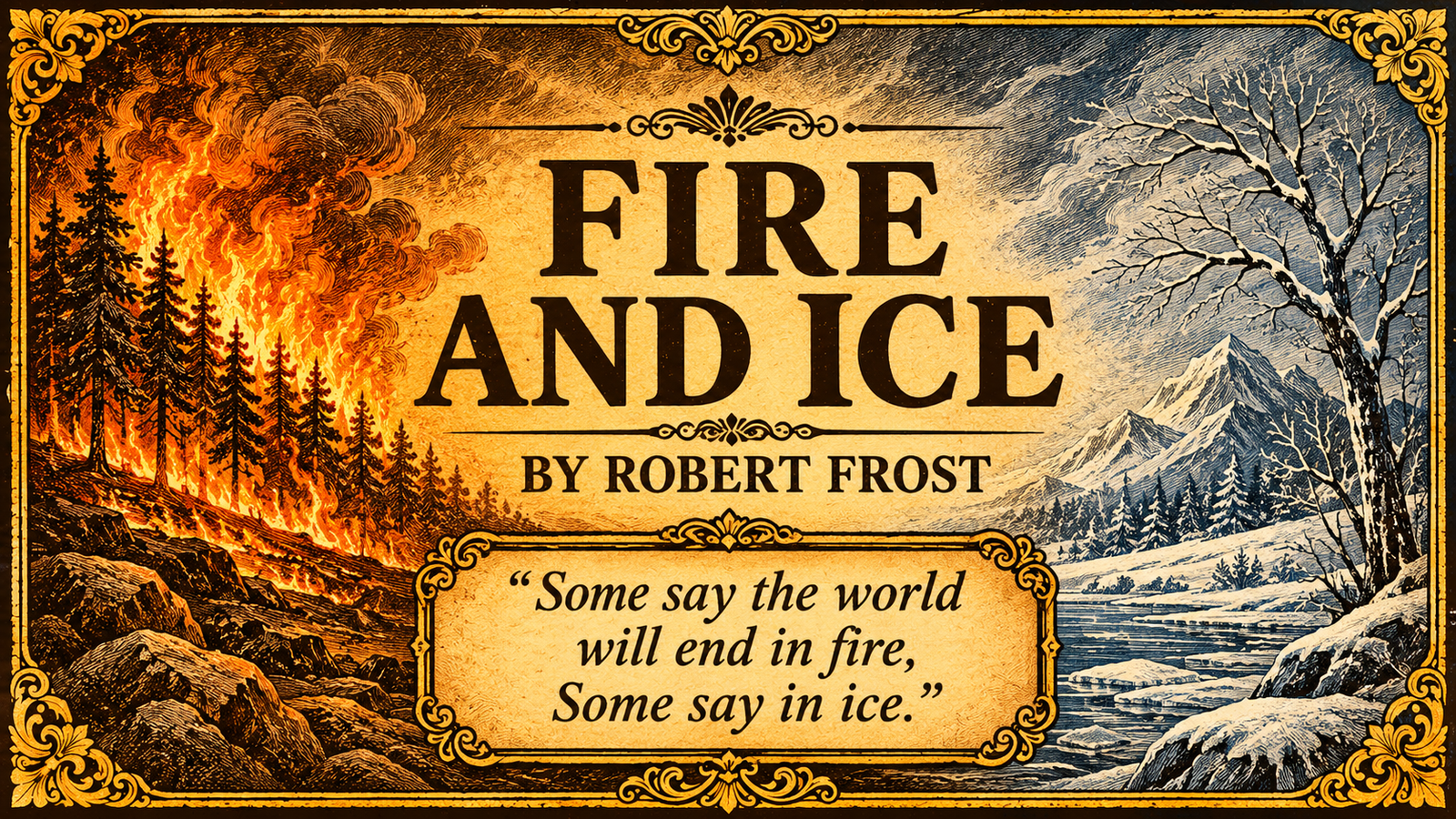
Fire and Ice is a poem considering how the world might end, comparing the destructive forces of “fire” (equated with human desire) and “ice” (equated with hate), concluding that both are fully capable of bringing about destruction.
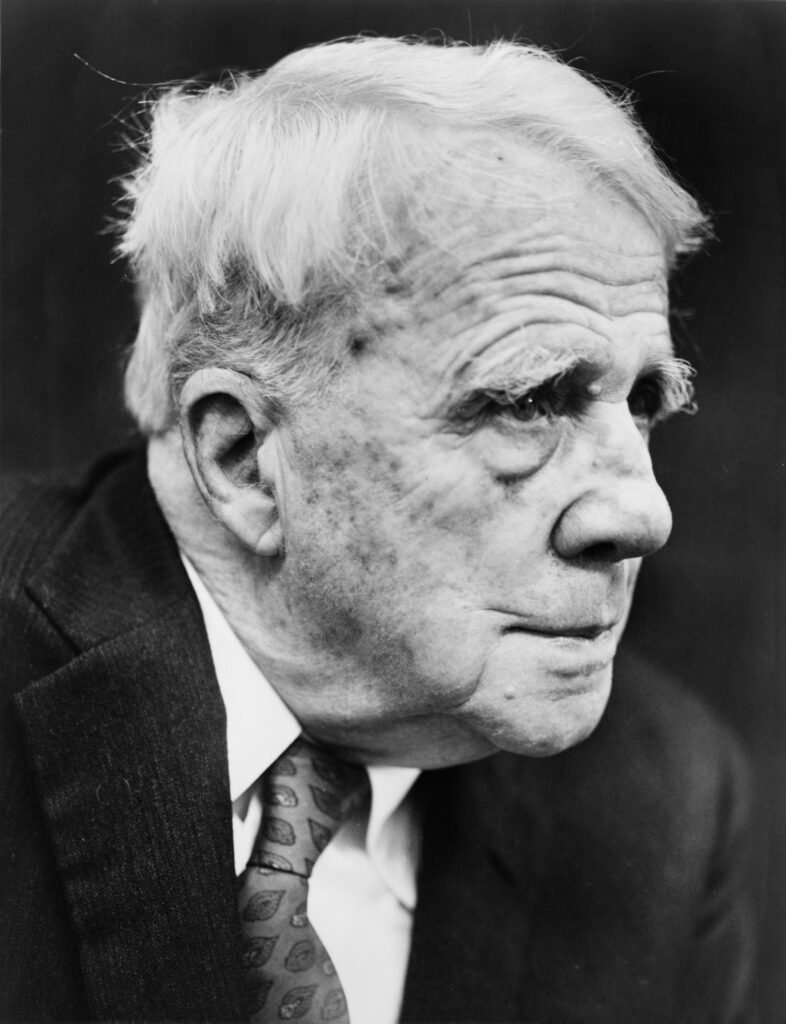
Robert Lee Frost (March 26, 1874 – January 29, 1963) was an American poet celebrated for his realistic depictions of rural New England life and his deep mastery of American colloquial speech.
Quick Facts
Major Honors: He is the only poet in history to win four Pulitzer Prizes for Poetry (A Further Range, New Hampshire, A Witness Tree, and Collected Poems). He also recited his poem “The Gift Outright” at the inauguration of President John F. Kennedy in 1961.
Birth & Death: Born in San Francisco, California, and moved to New England as a boy after his father’s death; died in Boston, Massachusetts.
Literary Style: Blended traditional verse forms with conversational rhythms and everyday language to explore complex human, social, and philosophical themes.
Famous Works:
“The Road Not Taken”
“Stopping by Woods on a Snowy Evening”
“Mending Wall”
“Fire and Ice”
He is the only poet in history to win four Pulitzer Prizes for Poetry (A Further Range, New Hampshire, A Witness Tree, and Collected Poems). He also recited his poem “The Gift Outright” at the inauguration of President John F. Kennedy in 1961.
Summary:
- The Core Debate: The speaker outlines two competing arguments regarding how the world will eventually end—either in fire or in ice.
- Desire and Fire: Drawing from personal experience with human desire, the speaker initially aligns with those who believe fire will bring about the world’s end.
- Hate and Ice: The speaker acknowledges that if the world were to perish a second time, personal experience with hate demonstrates that ice is also a great force for destruction and would fully suffice.
Explanation, Meaning and Annotation:
Line by line meanings:
- “Some say the world will end in fire”: Cites one common viewpoint that the world will be destroyed by fire.
- “Some say in ice.”: Cites an alternative viewpoint that the world will end in ice.
- “From what I’ve tasted of desire”: References the speaker’s personal experience with desire.
- “I hold with those who favour fire.”: Expresses agreement with those who believe fire will cause the world’s destruction.
- “But if it had to perish twice,”: Considers a hypothetical scenario in which the world must be destroyed a second time.
- “I think I know enough of hate”: References the speaker’s experience with human hatred.
- “To say that for destruction ice”: Identifies ice as an effective force for destruction.
- “Is also great”: Affirms that ice is powerful enough to cause destruction.
- “And would suffice.”: Concludes that ice would be completely sufficient to bring about the end.
Important Word Meanings:
- Desire – Appears in the line “From what I’ve tasted of desire”.
- Favour – Appears in the line “I hold with those who favour fire”.
- Perish – Appears in the line “But if it had to perish twice”.
- Suffice – Appears in the line “And would suffice”.
Literary and Poetic Devices:
Symbolism & Unconventional Imagery:
“Fire” symbolizes violent human passions, uncontrolled desires, greed, and lust. “Ice” symbolizes cold hatred, rigidity, indifference, and apathy.
Rhyme Scheme & Enjambment:
Uses a compact, interlocking rhyme scheme (ABA BCB CDE or ABAA BCBCB) linking fire/desire/fire, ice/twice/suffice, and hate/great.
Anaphora: Repetition of a phrase at the start of consecutive lines:
- “ Some say the world will end in fire / Some say in ice”.
Alliteration: Repetition of initial consonant sounds:
- “ S ome s ay” (/s/ sound).
- “ f avour f ire” (/f/ sound).
- “ w orld w ill” (/w/ sound).
Assonance: Repetition of vowel sounds, such as the /o/ sound in “I h o ld with th o se who fav o *r fire”.
Literary & Figurative Devices:
Symbolism:
- Fire: Represents burning human passion, lust, desire, and greed.
- Ice: Represents cold hatred, indifference, rigidity, and apathy.
Personification: Elemental forces (Fire and Ice) are given agency as destructive entities capable of ending the world.
Understatement & Irony: The closing lines (“To say that for destruction ice / Is also great / And would suffice”) use a quiet, understated tone to highlight the terrifying power of hatred
Inner meaning of the poem:
- The Inner Meaning: The poem serves as a philosophical warning about the destructive capacity of human emotions.
- Fire represents Desire: The speaker draws from personal experience (“tasted of desire”) to align with those who believe fire will end the world, pointing to how unbridled passion, greed, and obsession can consume human existence.
- Ice represents Hate: The speaker reflects on personal acquaintance with hatred (“know enough of hate”) to conclude that ice is equally powerful (“Is also great / And would suffice”), signifying that cold indifference, apathy, and hostility can be just as fatal.
- The core message is that both fiery passion and cold hatred are potent forces capable of bringing about total destruction.
Textual Exercise Answers
1. There are many ideas about how the world will ‘end’. Do you think the world will end some day? Have you ever thought what would happen if the sun got so hot that it ‘burst’, or grew colder and colder?
Answer:
Yes, I think the world will end someday. If the Sun became extremely hot and burst, the Earth would become unbearably hot, destroying all life through fire. On the other hand, if the Sun grew colder and colder, the Earth would freeze, making life impossible. Thus, the world could end either through extreme heat or extreme cold.
2. For Frost, what do ‘fire’ and ‘ice’ stand for? Here are some ideas: greed, avarice, cruelty, lust, conflict, fury, intolerance, rigidity, insensitivity, coldness, indifference, hatred.
Answer:
In the poem, fire represents intense human desires and passions such as greed, lust and uncontrolled anger. Ice represents cold emotions such as hatred, cruelty and indifference. The poet suggests that both uncontrolled desires and hatred can lead to the destruction of the world.
3. What is the rhyme scheme of the poem? How does it help in bringing out the contrasting ideas in the poem?
Answer:
The rhyme scheme of the poem is ABA ABC BCB.
The rhyming words are fire–desire, ice–twice–suffice and hate–great. This rhyme scheme gives the poem a musical effect and connects the contrasting ideas of fire and ice. It also emphasises that both desire and hatred can lead to destruction.
EXPLANATION VIDEO – COMING SOON
Leave a Reply