
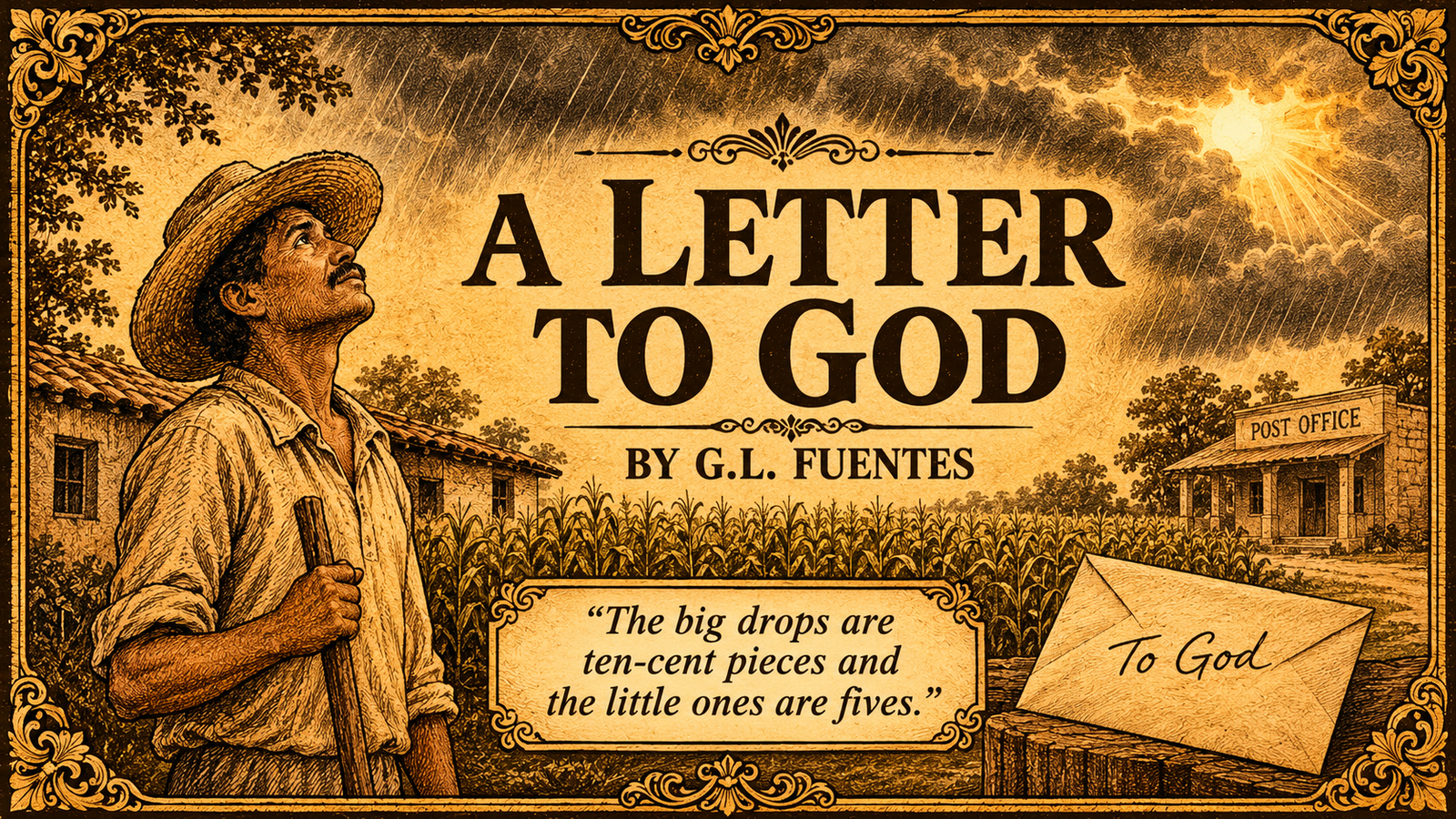
“A Letter to God” by G.L. Fuentes, which explores profound themes of unwavering belief and human nature. It introduces Lencho, an agricultural worker whose valuable corn crop is completely ruined by a severe and unexpected hailstorm. Driven by absolute conviction, he pens a direct plea to the Almighty requesting one hundred pesos to feed his family and restart his farming. Upon discovering this unusual mail, the postmaster and his colleagues decide to collect and contribute their own funds to protect the writer’s strong religious trust. However, when Lencho receives only a portion of the requested sum, he feels frustrated and mistakenly accuses the helpful post office workers of dishonesty.
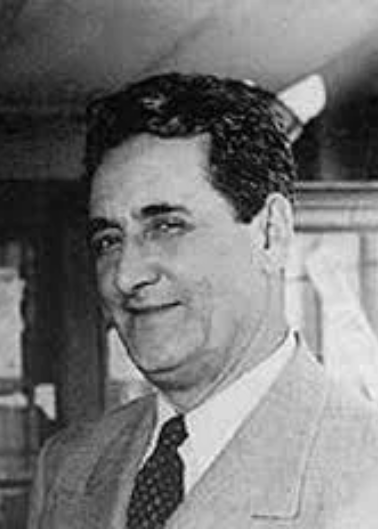
G.L. Fuentes, whose full name is Gregorio López y Fuentes (November 17, 1897 – December 10, 1966), was a prominent Mexican novelist, poet, and journalist. He is best known as a key chronicler of the Mexican Revolution and for writing the famous short story “A Letter to God”, which is featured in the CBSE Class 10 English textbook.
Quick Facts
- Birth and Background: Born on a ranch in the Huasteca region of Veracruz, Mexico. Growing up in his father’s general store, he interacted closely with local farmers, laborers, and indigenous people, shaping his deep social insight.
- Literary Style: His writing focuses on rural life, peasant struggles, social justice, and the aftermath of the Revolution.
- Major Works:
- Campamento (1931)
- Tierra (1932) – a novel about revolutionary leader Emiliano Zapata
- ¡Mi general! (1934)
- El indio (1935) – his most celebrated work, which won the National Prize of Arts and Sciences in 1935.
Summary:
- Setting the Scene & Anticipating Rain: Lencho, a hard-working farmer, lives with his family in the only house sitting on the crest of a low hill overlooking the river and his cornfield. Knowing his fields intimately, he spends the morning watching the north-east sky in hopes of a much-needed downpour or shower to ensure a bountiful harvest.
- The Arrival of the Rain: During supper, giant drops of rain begin to fall from the north-east sky just as Lencho predicted. Filled with joy, Lencho walks outside to feel the rain and exuberantly compares the big raindrops to ten-cent coins and the small ones to five-cent coins, seeing them as wealth for his crops.
- The Devastating Hailstorm: The mood turns grim when a violent wind sweeps in, bringing large hailstones that pelt the valley like silver coins. For an hour, hail rains relentlessly over the house, garden, hillside, and cornfield, leaving the entire valley covered in white as if coated in salt.
- Destruction & Despair: The severe storm strips every leaf from the trees, ruins the blossoms, and completely destroys Lencho’s corn. Standing in the middle of his ruined field, a sorrowful Lencho tells his sons that even a plague of locusts would have left more behind, lamenting that they will face a year of hunger with no corn left.
- Unwavering Faith in God: Despite the total loss, the family holds onto a single ray of hope: help from God. Comforting his family with the belief that “no one dies of hunger,” Lencho spends the night remembering that God sees everything, even deep within one’s conscience, and resolves to write a letter asking for help.
- Writing & Mailing the Letter: At daybreak on Sunday, Lencho writes a letter asking God for one hundred pesos to re-sow his fields and sustain his family until the next crop grows. He addresses the envelope simply “To God”, travels to town, attaches a stamp, and drops it into the post office mailbox.
- The Postmaster’s Reaction: A postman retrieves the letter and shows it to the postmaster while laughing at the unknown address. Though the fat, amiable postmaster initially laughs as well, he quickly becomes serious, admiring Lencho’s astonishing faith and resolving to answer the letter so the farmer’s confidence in God remains unbroken.
- Raising Funds for Charity: Realizing that a true response requires money rather than just paper and ink, the postmaster collects donations from his staff, contributes part of his own salary, and asks friends for contributions as an act of charity. Unable to raise the full hundred pesos, he manages to gather seventy pesos, places the money in an envelope addressed to Lencho, and signs it simply “God”.
- Receiving the Partial Reply: The following Sunday, Lencho arrives early at the post office to check for mail. Handed the envelope by the postman while the postmaster looks on with satisfaction, Lencho shows no surprise at receiving money from God; however, he becomes furious upon counting it, certain that God could neither make a mistake nor deny his request.
- The Second Letter & Central Irony: Lencho immediately goes to the writing table, writes a second letter with much brow-wrinkling, affixes a stamp with a blow of his fist, and drops it into the mailbox. When the postmaster opens the letter, Lencho asks God to send the remaining thirty pesos directly to him—imploring Him not to send it through the mail because the post office staff are a “bunch of crooks”.
Word Meanings and Annotations:
- Crest: The top or highest point of a hill.
- Downpour: A heavy and sudden rainfall.
- Shower: A light or brief fall of rain.
- Intimately: Closely and thoroughly, showing deep personal knowledge.
- Predicted: Stated or foretold that something would happen before it occurred.
- Regarded: Observed or looked at attentively.
- Draped: Covered or wrapped loosely (as if with a cloth or curtain).
- Hailstones: Pellets or small balls of frozen rain.
- Resembled: Looked like or possessed similar characteristics to something else.
- Plague: A destructive infestation or widespread outbreak that causes severe damage.
- Locusts: Migratory insects that fly in massive swarms and consume crops and foliage.
- Sorrowful: Feeling, expressing, or inducing deep grief and sadness.
- Solitary: Single, isolated, or living alone in a secluded place.
- Conscience: An inner moral sense that guides a person’s perception of right and wrong.
- Ox of a man: An idiomatic expression describing a person who is extremely strong and works relentlessly like a farm animal.
- Daybreak: The first appearance of light in the morning; dawn.
- Pesos: The monetary currency unit used in Mexico and several Latin American nations.
- Sow: To plant seeds in the earth for growing crops.
- Amiable: Friendly, warm-hearted, and pleasant in manner.
- Correspondence: Communication maintained by exchanging written letters.
- Resolution: A firm decision or steadfast intent to accomplish a goal.
- Goodwill: Friendly, helpful, or cooperative feelings toward others.
- Obliged: Morally bound, compelled, or required to perform a helpful action.
- Charity: Voluntary giving of financial assistance or provisions to those in need.
- Contentment: A state of peaceful satisfaction and happiness with one’s actions or circumstances.
- Denied: Refused to give or grant something requested.
- Brow: The forehead, particularly when creased or wrinkled during intense thought or effort.
- Affixed: Attached, stuck, or fastened onto an object.
- Crooks: Dishonest persons, swindlers, or thieves.
Textual Exercise Solutions:
Thinking about the text:
1. Who or what did Lencho have faith in? What did he do?
Lencho had deep, unshakeable faith in God. He believed that God’s eyes see everything—even what is deep within one’s conscience—and that no one dies of hunger.
When a severe hailstorm completely destroyed his cornfield and left his family facing starvation, he wrote a letter addressed directly to God requesting 100 pesos to re-sow his fields and support his family until the next harvest.
2. Why does the postmaster send money to Lencho? Why does he sign the letter ‘God’?
The postmaster was amazed by Lencho’s extraordinary faith and wished he possessed the same deep trust in God. To ensure that Lencho’s faith would not be shaken, he decided to answer the letter.
Because answering required money, he collected contributions from his employees, gave a portion of his own salary, and asked friends for charity donations, raising 70 pesos. He signed the letter “God” so Lencho would believe the reply and money came directly from God.
3. Did Lencho try to find out who had sent the money to him? Why or why not?
No, Lencho did not try to find out who sent the money. He showed not the slightest bit of surprise upon opening the envelope and finding the money, as his confidence in God’s responsiveness was absolute. He was certain that God had received his request and fulfilled it directly.
4. Who does Lencho think has taken the rest of the money? What is the irony in the situation?
Lencho believes that the post office employees stole the remaining 30 pesos from the 100 pesos he requested.
- The Irony: The irony lies in the fact that the post office workers whom Lencho accuses of being a “bunch of crooks” are the very people who generously gave their own money to help him out of kindness.
5. Are there people like Lencho in the real world? What kind of a person would you say he is?
It is extremely rare to find people like Lencho in the real world, as most individuals would question receiving money in the mail without a return sender’s address. Lencho can be characterized as:
- Naïve and Unquestioning: He innocently believes God will directly mail cash to a local post office without doubting the logistics.
- Hardworking: He is described as “an ox of a man,” working tirelessly like an animal in his fields.
- Innocent yet Distrustful: While his faith in God is pure, his extreme naïvety leads him to unfairly suspect the post office workers of theft.
6. There are two kinds of conflict in the story: between humans and nature, and between humans themselves. How are these conflicts illustrated?
- Conflict between Humans and Nature: Illustrated by the violent hailstorm that destroys Lencho’s ripe cornfield. Despite Lencho’s hard labor, nature ruins the crop in an hour, leaving the family helpless.
- Conflict between Humans and Humans: Illustrated by the deep mistrust between Lencho and the postal workers. Despite the postmaster and his staff acting out of pure generosity, Lencho misjudges their motives and accuses them of being dishonest.
Thinking about language:
I. Types of Storms (Vocabulary Matching)
Match the names in the box (gale, whirlwind, cyclone, hurricane, tornado, typhoon) with their descriptions:
- A violent tropical storm in which strong winds move in a circle: Cyclone
- An extremely strong wind: Gale
- A violent tropical storm with very strong winds: Typhoon
- A violent storm whose centre is a cloud in the shape of a funnel: Tornado
- A violent storm with very strong winds, especially in the western Atlantic Ocean: Hurricane
- A very strong wind that moves very fast in a spinning movement and causes a lot of damage: Whirlwind
II. Meanings of ‘Hope’
Matching sentences in Column A with the corresponding meanings of ‘hope’ in Column B:
- Will you get the subjects you want to study in college? I hope so.
- Meaning: Wanting something to happen (and thinking it quite possible)
- I hope you don’t mind my saying this, but I don’t like the way you are arguing.
- Meaning: Showing concern that what you say should not offend or disturb the other person: a way of being polite
- This discovery will give new hope to HIV/AIDS sufferers.
- Meaning: A feeling that something good will probably happen
- We were hoping against hope that the judges would not notice our mistakes.
- Meaning: Wishing for something to happen, although this is very unlikely
- I called early in the hope of speaking to her before she went to school.
- Meaning: Thinking that this would happen (It may or may not have happened.)
- Just when everybody had given up hope, the fishermen came back, seven days after the cyclone.
- Meaning: Stopped believing that this good thing would happen
III. Relative Clauses
Join each pair of sentences using the relative pronoun provided in brackets:
- I often go to Mumbai. Mumbai is the commercial capital of India.(which)
- Answer: I often go to Mumbai, which is the commercial capital of India.
- My mother is going to host a TV show on cooking. She cooks very well.(who)
- Answer: My mother, who cooks very well, is going to host a TV show on cooking.
- These sportspersons are going to meet the President. Their performance has been excellent.(whose)
- Answer: These sportspersons, whose performance has been excellent, are going to meet the President.
- Lencho prayed to God. His eyes see into our minds.(whose)
- Answer: Lencho prayed to God, whose eyes see into our minds.
- This man cheated me. I trusted him.(whom)
- Answer: This man, whom I trusted, cheated me.
IV. Using Negatives for Emphasis
Find sentences from the story with negative words that express these ideas emphatically:
- The trees lost all their leaves.
- Sentence from story: “Not a leaf remained on the trees.”
- The letter was addressed to God himself.
- Sentence from story: “It was nothing less than a letter to God.”
- The postman saw this address for the first time in his career.
- Sentence from story: “Never in his career as a postman had he known that address.”
V. Metaphors
Complete the table identifying metaphors used in the text and the qualities being compared:
| Object | Metaphor in Story | Quality or Feature Compared |
|---|---|---|
| Clouds | Huge mountains of clouds | The mass or ‘hugeness’ of mountains |
| Raindrops | New coins (big drops are ten-cent pieces, little ones are fives) | Monetary value, wealth, and prosperity promised by a good harvest |
| Hailstones | New silver coins / frozen pearls | Bright white, shiny appearance, and hard rounded shape |
| Locusts | A plague of locusts | Widespread devastation and destruction left behind |
| Lencho | An ox of a man | Physical strength, relentless hard labor, and endurance |
Writings:
Writing Exercise Prompt
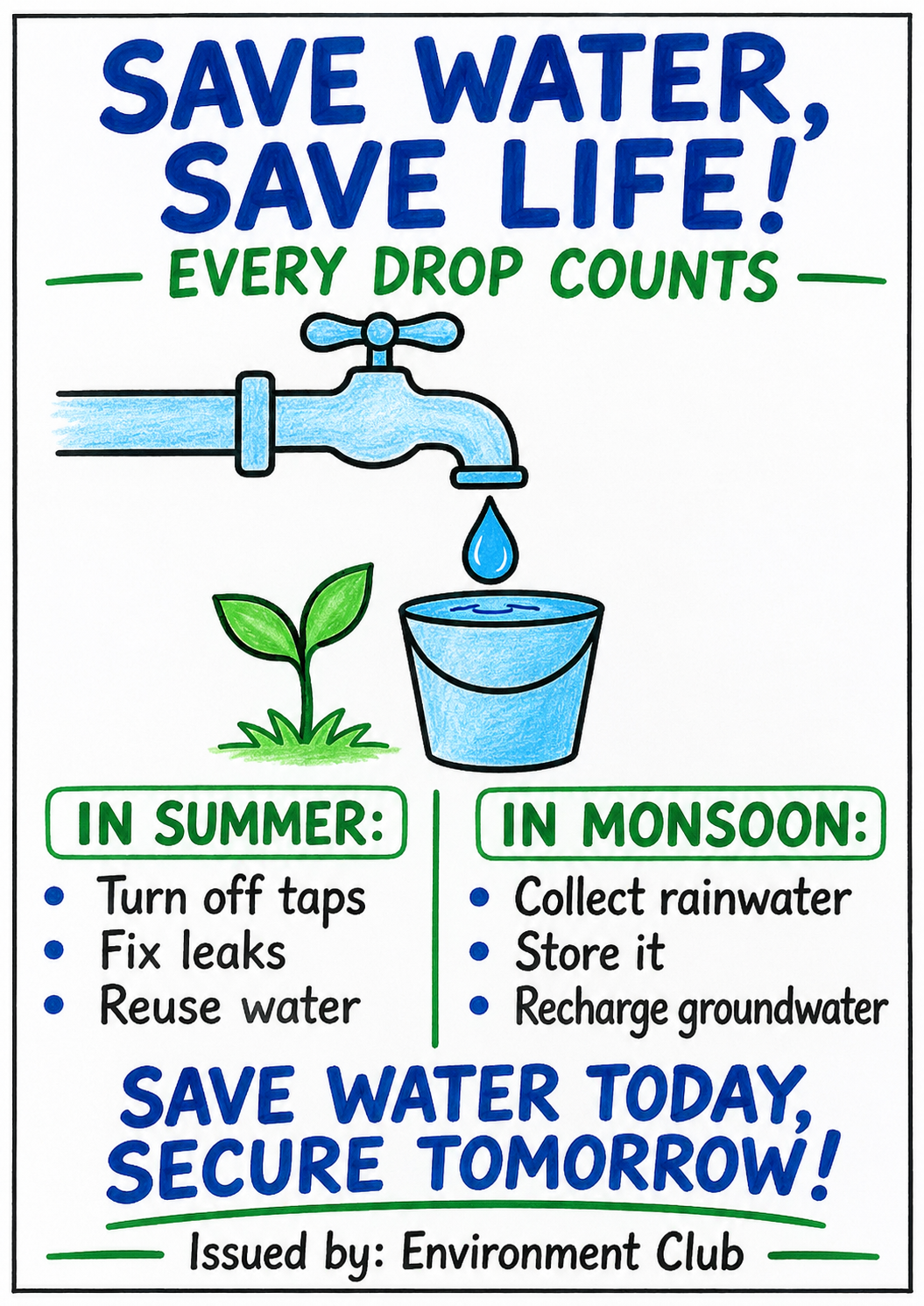
“Lencho suffered first due to drought and then by floods. Our country is also facing such situations in recent years. There is flood and there is drought. There is a need to save water through water harvesting. Design a poster for your area on how to save water during summer and when it is available in excess.”
Sample Poster Content
|                    SAVE WATER, SECURE OUR FUTURE!
|             "Every Drop Counts — Harvest Rain, Beat Drought"
|  --------------------------------------------------------------------------  |
|  1. WATER CONSERVATION DURING SUMMER (DRY PERIODS):                          |
|     - Fix leaky taps, pipes, and flush tanks immediately.
|     - Turn off the tap while brushing teeth and washing hands.
|     - Reuse kitchen wastewater (greywater) for watering garden plants.
|     - Use buckets instead of running hoses for bathing and washing vehicles.
|  --------------------------------------------------------------------------  |
|  2. WATER HARVESTING WHEN AVAILABLE IN EXCESS (MONSOON & FLOODS):            |
|     - Install Rooftop Rainwater Harvesting (RWH) systems to recharge
|       underground aquifers.                                                  |
|     - Construct percolation pits and recharge wells in residential areas.
|     - Store surplus rainwater in covered storage tanks for domestic use.
|     - Prevent runoff by creating small check dams and contour bunds.
|  --------------------------------------------------------------------------  |
|                         GOLDEN RULE FOR EVERY CITIZEN:                       |
|            "SAVE WATER TODAY TO SURVIVE TOMORROW!"                           |
|                                                                              |
|  Issued in Public Interest By:                                               |
|  Environment Club & Resident Welfare Association (RWA)
Sample Poster Design

Leave a Reply