




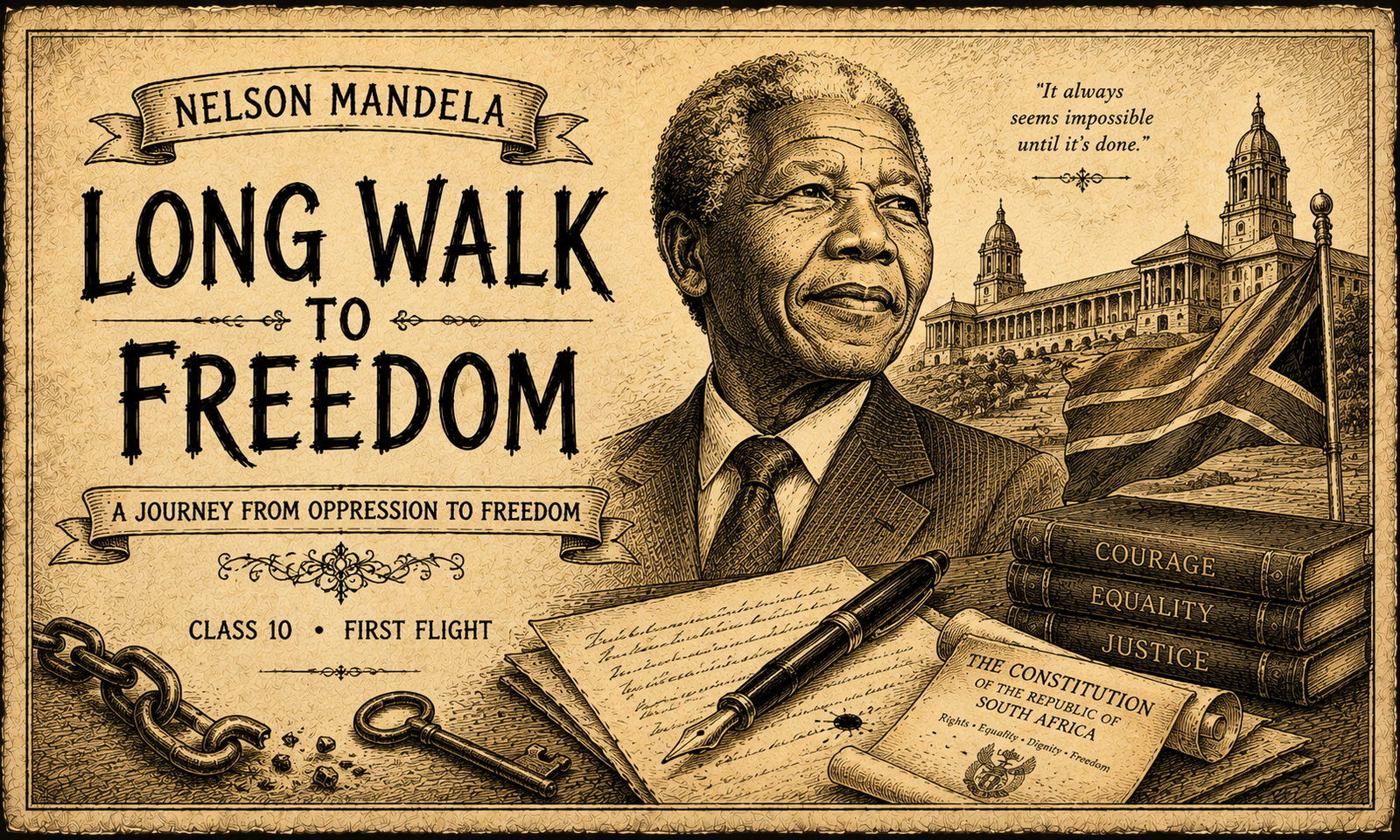
This prose piece details theNelson Mandela: Long Walk to Freedom is an inspiring autobiographical extract by Nelson Mandela, taken from his famous autobiography, Long Walk to Freedom. The chapter recounts the historic day of 10 May 1994, when Mandela was sworn in as the first democratically elected Black President of South Africa, marking the end of apartheid and the beginning of a new era of equality and democracy.
Through his inaugural speech and personal reflections, Mandela highlights the sacrifices made by countless freedom fighters, the importance of courage, forgiveness, unity, and the belief that true freedom can exist only when every individual enjoys equal rights and dignity. The chapter is not merely a record of a political event but a timeless message about justice, humanity, reconciliation, and the power of hope to overcome oppression. history, cultural significance, and regional diversity of the pankha, or traditional Indian hand fan. Tracing its origins to the Sanskrit word for feather, the text explores how these objects evolved from ancient religious and royal tools into celebrated decorative crafts. Various states like Rajasthan, Gujarat and West Bengal are highlighted for their unique construction methods, utilizing materials such as palm leaves, beads and gold threadwork. Beyond physical descriptions, the documents emphasize the industrious artisans who maintain these traditions in the face of modern technological competition.
About Nelson Mandela
Nelson Mandela was one of the greatest leaders and human rights activists in history. He was born on 18 July 1918 in Mvezo, South Africa. He dedicated his life to ending the cruel system of apartheid, which discriminated against Black South Africans on the basis of race.
Mandela joined the African National Congress (ANC) and led the struggle for equality, justice, and democracy. Because of his fight against apartheid, he was arrested and spent 27 years in prison. Despite his long imprisonment, he never gave up hope or sought revenge.
In 1994, after South Africa’s first democratic elections, Mandela became the first Black President of South Africa. His presidency marked the end of apartheid and the beginning of a democratic, non-racial nation. He promoted peace, reconciliation, forgiveness, and equal rights for all citizens.
Mandela’s autobiography, Long Walk to Freedom, reflects his inspiring journey from oppression to freedom. He believed that courage is not the absence of fear, but the triumph over it, and that no one is born hating another person. His life remains a symbol of resilience, humanity, justice, and the power of forgiveness.
Key Facts
- Full Name: Nelson Rolihlahla Mandela
- Born: 18 July 1918
- Birthplace: Mvezo, South Africa
- Political Party: African National Congress (ANC)
- Known For: Fighting against apartheid
- Years in Prison: 27 years
- President of South Africa: 1994–1999
- Autobiography: Long Walk to Freedom
- Nobel Peace Prize: 1993 (shared with F. W. de Klerk)
- Died: 5 December 2013
Values We Learn from Nelson Mandela
- Courage
- Perseverance
- Forgiveness
- Equality
- Justice
- Leadership
- Humanity
- Respect for all people
Summary:
The chapter begins on 10 May 1994, the day Nelson Mandela was sworn in as the first Black President of democratic South Africa. The weather was bright and pleasant, symbolizing hope and a new beginning. In the days leading up to the inauguration, Mandela was surrounded by world leaders and dignitaries who had come to honour this historic occasion. The ceremony became the largest gathering of international leaders ever held in South Africa, showing the world’s support for the country’s transition to democracy.
The inauguration was held at the Union Buildings in Pretoria, which had once been the centre of white supremacy during apartheid. For many years, these buildings symbolized racial discrimination and oppression. On this historic day, however, they became the meeting place of people from different races and countries—a “rainbow gathering.” This transformation represented South Africa’s journey from racial segregation to equality and democracy.
Mandela attended the ceremony with his daughter, Zenani. Before him, F.W. de Klerk took the oath as the Second Deputy President, followed by Thabo Mbeki as the First Deputy President. When Mandela took the oath as President, he promised to protect the Constitution and work for the welfare of all South Africans. In his inaugural speech, he thanked the international community for supporting South Africa and declared that apartheid had finally ended. He pledged to remove poverty, discrimination, and injustice and promised that oppression would never return.
After the oath-taking ceremony, military aircraft flew over the Union Buildings in perfect formation. The display represented more than military strength—it symbolized the armed forces’ loyalty to the newly elected democratic government. Mandela reflected on how the same military officers who once considered him a criminal now saluted him as their President. Jets released smoke in the colours of the new South African flag, representing national pride and unity.
The ceremony included the singing of both South African national anthems. White citizens sang “Nkosi Sikelel’ iAfrika”, while Black citizens sang “Die Stem,” the old national anthem. Although many people did not yet know the words, Mandela believed that they would soon learn them. This symbolized forgiveness, reconciliation, and the willingness of both communities to respect each other’s traditions.
Mandela reflected on South Africa’s painful history. After the Anglo-Boer War, white rulers united to establish apartheid, creating one of the world’s most unjust systems. For decades, Black South Africans suffered discrimination and oppression. Now, after many years of struggle, that cruel system had been replaced by a democratic government that guaranteed equal rights to all citizens regardless of race.
Mandela acknowledged that his presidency was possible only because of the sacrifices made by thousands of freedom fighters before him. He felt that he was merely continuing their struggle. He expressed sadness that many of these heroes did not live to witness South Africa’s freedom. He also praised great leaders such as Oliver Tambo, Walter Sisulu, Chief Luthuli, Yusuf Dadoo, Bram Fischer, and Robert Sobukwe, whose courage and dedication inspired the nation.
Mandela explained that he learned the true meaning of courage from his fellow freedom fighters. Courage does not mean being free from fear; instead, it means overcoming fear. He had seen ordinary people endure imprisonment, torture, and even death without giving up. Their determination taught him that bravery is measured by one’s ability to conquer fear.
Mandela believed that hatred is not natural—it is learned. Since people can learn to hate, they can also be taught to love. Even during his years in prison, he occasionally saw kindness in the guards. These small moments convinced him that human goodness can never be completely destroyed. He compared goodness to a flame that may be hidden but can never be extinguished.
Mandela explained that every person has two responsibilities—towards family and towards society. Under apartheid, Black South Africans found it almost impossible to fulfill both duties. Those who fought for justice were separated from their families. Mandela himself had to sacrifice his roles as a son, husband, and father in order to serve his people.
Mandela remembered his childhood when he believed he was completely free. He enjoyed playing, swimming, herding cattle, and following tribal customs. As he grew older, however, he realized that these freedoms were only temporary because apartheid laws restricted his opportunities and rights.
At first, Mandela wanted only personal freedom—the freedom to study, work, marry, and live peacefully. Later, he realized that millions of Black South Africans were denied these same rights. His personal struggle became a collective struggle for justice. This realization transformed him into a fearless leader willing to sacrifice everything for his country’s freedom.
Mandela concludes by explaining that freedom cannot be divided. If one person is oppressed, everyone is affected. He also believes that oppressors are not truly free because hatred and prejudice imprison them morally. Therefore, both the oppressed and the oppressor need liberation to regain their humanity. This powerful message emphasizes universal freedom, equality, and compassion.
Word Meaning:
| Word | Meaning |
|---|---|
| Apartheid | A system of racial segregation and discrimination. |
| Dawned | Began; started. |
| Besieged | Surrounded closely by many people. |
| Dignitaries | Important officials or respected persons. |
| Inauguration | The formal ceremony of assuming an important office. |
| Amphitheatre | A large open-air venue with rising rows of seats. |
| Supremacy | The state of being the highest in authority or power. |
| Rainbow Gathering | A coming together of people from different races and nations. |
| Sworn in | Officially took an oath before assuming office. |
| Pledged | Made a solemn promise. |
| Uphold | To support or maintain. |
| Constitution | The supreme set of laws governing a country. |
| Devote | To dedicate completely. |
| Confer | To grant or bestow. |
| Liberty | Freedom. |
| Outlaws | People declared outside the protection of the law. |
| Privilege | A special right or honour. |
| Emancipation | Freedom from control or restriction. |
| Bondage | State of being enslaved or oppressed. |
| Deprivation | Lack of basic necessities or rights. |
| Discrimination | Unfair treatment based on race, gender, religion, etc. |
| Oppression | Cruel or unjust treatment of people. |
| Spectacular | Very impressive or beautiful. |
| Array | An impressive display or arrangement. |
| Pinpoint Precision | Perfect accuracy. |
| Loyalty | Faithfulness or devotion. |
| Bedecked | Decorated or adorned. |
| Unmindful | Aware of; conscious of. |
| Chevron | A V-shaped pattern. |
| Despised | Strongly disliked or looked down upon. |
| Overwhelmed | Deeply affected emotionally. |
| Domination | Control over others. |
| Inhumane | Cruel; lacking compassion. |
| Overturned | Completely ended or abolished. |
| Recognised | Accepted or acknowledged. |
| Sacrifices | Acts of giving up something valuable for a noble cause. |
| Patriots | People who love and serve their country. |
| Wrought | Achieved; brought about. |
| Profound | Deep and intense. |
| Brutality | Extreme cruelty. |
| Generosity | Willingness to give and help others. |
| Resilience | Ability to recover quickly from hardship. |
| Triumph | A great victory or success. |
| Glimmer | A faint sign or small amount. |
| Reassure | To remove fear or doubt. |
| Extinguished | Put out completely. |
| Humane | Kind and compassionate. |
| Obligations | Duties or responsibilities. |
| Inclinations | Natural preferences or tendencies. |
| Isolated | Separated from others. |
| Inevitably | Unavoidably. |
| Twilight Existence | A secret and uncertain way of living. |
| Abided | Followed or obeyed. |
| Illusion | Something that appears real but is not. |
| Transitory | Temporary; short-lived. |
| Yearned | Longed deeply for. |
| Potential | Hidden ability or capability. |
| Obstructed | Prevented or blocked. |
| Curtailed | Reduced or limited. |
| Animated | Inspired or motivated. |
| Virtuous | Morally good. |
| Self-sacrificing | Willing to give up personal comfort for others. |
| Indivisible | Unable to be divided. |
| Oppressor | A person who treats others cruelly and unjustly. |
| Oppressed | A person suffering from injustice or cruelty. |
| Prejudice | Unfair opinion without proper knowledge. |
| Narrow-mindedness | Lack of openness to different ideas or people. |
| Humanity | Compassion, kindness, and respect for others. |
Textual Exercise Solutions
Thinking about the text:
1. Why did such a large number of international leaders attend the inauguration? What did it signify the triumph of?
2. What does Mandela mean when he says he is “simply the sum of all those
African patriots” who had gone before him?
3. Would you agree that the “depths of oppression” create “heights of character”? How does Mandela illustrate this? Can you add your own examples to this argument?
4. How did Mandela’s understanding of freedom change with age and experience?
5. How did Mandela’s ‘hunger for freedom’ change his life?
Answers
- Many international leaders attended the inauguration because it marked the end of apartheid and the birth of a democratic South Africa. Their presence showed the world’s respect for Mandela and symbolised the triumph of democracy, justice, equality and human dignity.
2. Mandela means that his achievements were possible only because of the sacrifices made by countless freedom fighters before him. He considered himself a representative of their courage, dedication, and struggle.
3. Yes. Great suffering often brings out extraordinary courage and determination. Mandela explains that apartheid produced remarkable leaders such as Oliver Tambo, Walter Sisulu, Chief Luthuli, Yusuf Dadoo, Bram Fischer, and Robert Sobukwe, whose bravery and wisdom inspired the struggle for freedom.
4. As a child, Mandela believed freedom meant enjoying a carefree life. As he grew older, he realised that apartheid denied basic human rights. His desire for personal freedom gradually became a struggle for the freedom of all South Africans.
5. Mandela’s desire for freedom transformed him from a timid young man into a courageous leader. He sacrificed his career, family life, and personal comfort to fight against apartheid. His struggle made him a symbol of justice and equality.
Thinking about Language:
I. There are nouns in the text (formation, government) which are formed from the corresponding verbs (form, govern) by suffixing -(at)ion or ment. There may be a change in the spelling of some verb – noun pairs: such as rebel, rebellion; constitute, constitution.
- Make a list of such pairs of nouns and verbs in the text.
NOUN
rebellion
constitution
VERB
rebel
constitute
Answers
List from text:
Installation (Install)
Oppression (Oppress)
Imagination (Imagine)
Emancipation (Emancipate)
Deprivation (Deprive)
2. Read the paragraph below. Fill in the blanks with the noun forms of the verbs in brackets.
Martin Luther King’s _ (contribute) to our history as an outstanding leader began when he came to the _ (assist) of Rosa Parks, a seamstress who refused to give up her seat on a bus to a white passenger. In those days American Blacks were confined to positions of second class citizenship by restrictive laws and customs. To break these laws would mean _ (subjugate) and _(humiliate) by the police and the legal system. Beatings, _
(imprison) and sometimes death awaited those who defied the System. Martin Luther King’s tactics of protest involved non-violent _(resist) to racial injustice.
Answers
| Verb | Noun |
|---|---|
| contribute | contribution |
| assist | assistance |
| subjugate | subjugation |
| humiliate | humiliation |
| imprison | imprisonment |
| resist | resistance |
III. Idiomatic Expressions
Match the italicised phrases in Column A with the phrase nearest in meaning in Column B. (Hint: First look for the sentence in the text in which the phrase in Column A occurs.)
Answers
| Column A | Correct Answer |
|---|---|
| 1. I was not unmindful of the fact | (i) had not forgotten; was aware of the fact |
| 2. When my comrades and I were pushed to our limits | (iii) felt that we could not endure the suffering any longer |
| 3. To reassure me and keep me going | (ii) help me continue to live in hope in this very difficult situation |
| 4. The basic and honourable freedoms of… earning my keep… | (i) earning enough money to live on |
Writings:
Use the following phrases to complete the sentences given below.
(i) they can be taught to love.
(ii) I was born free.
(iii) but the triumph over it.
(iv) but he who conquers that fear.
(v) to create such heights of character.
- It requires such depths of oppression
- Courage was not the absence of fear
- The brave man is not he who does not feel afraid
- If people can learn to hate
- I was not born with a hunger to be free.
Answers
- I was not born with a hunger to be free. I was born free.
2. It requires such depths of oppression to create such heights of character.
3. Courage was not the absence of fear but the triumph over it.
4. The brave man is not he who does not feel afraid but he who conquers that fear.
5. If people can learn to hate they can be taught to love.
II. This text repeatedly contrasts the past with the present or the future. We can use coordinated clauses to contrast two views, for emphasis or effect.
Given below are sentences carrying one part of the contrast. Find in the text the second part of the contrast, and complete each item. Identify the words which signal the contrast. This has been done for you in the first item.
- For decades the Union Buildings had been the seat of white supremacy,
and now … - Only moments before, the highest generals of the South African defence
force and police … saluted me and pledged their loyalty. … not so many
years before they would not have saluted - Although that day neither group knew the lyrics of the anthem …, they
would soon - My country is rich in the minerals and gems that lie beneath its soil,
- The Air Show was not only a display of pinpoint precision and military
force, but - It was this desire for the freedom of my people … that transformed
into a bold one, that drove to become a
criminal, that turned into a man without a home.
Answer
…it was the site of a rainbow gathering of different colours and nations for the installation of South Africa’s first democratic, non-racial government.
…but arrested me.
…know the words by heart.
…but I have always known that its greatest wealth is its people, finer and truer than the purest diamonds.
…a demonstration of the military’s loyalty to democracy, to a new government that had been freely and fairly elected.
…a frightened young man into a bold one, that drove a law-abiding attorney to become a criminal, that turned a family-loving husband into a man without a home.
III. Expressing Your Opinion
Do you think there is colour prejudice in our own country? Discuss this with your friend and write a paragraph of about 100 to 150 words about this. You have the option of making your paragraph a humorous one. (Read the short verse given below.)
When you were born you were pink
When you grew up you became white
When you are in the sun you are red
When you are sick you are yellow
When you are angry you are purple
When you are shocked you are grey
And you have the cheek to call me ‘coloured’.
Answers:
Yes, colour prejudice continues to exist in our country, although significant progress has been made in promoting equality and inclusiveness. People are sometimes judged or treated differently because of the colour of their skin, particularly in social interactions, employment opportunities and matrimonial preferences. Such discrimination is both unjust and harmful, as it undermines the principles of equality and human dignity. A person’s worth should be determined by character, integrity and ability rather than physical appearance. Every individual, irrespective of skin colour, deserves equal respect, opportunities and recognition. It is our collective responsibility to challenge stereotypes and foster a society founded on acceptance, compassion and mutual respect. As Nelson Mandela rightly observed, hatred is learned; therefore, people can also be taught to love, appreciate diversity, and uphold the values of humanity and equality.

Leave a Reply