




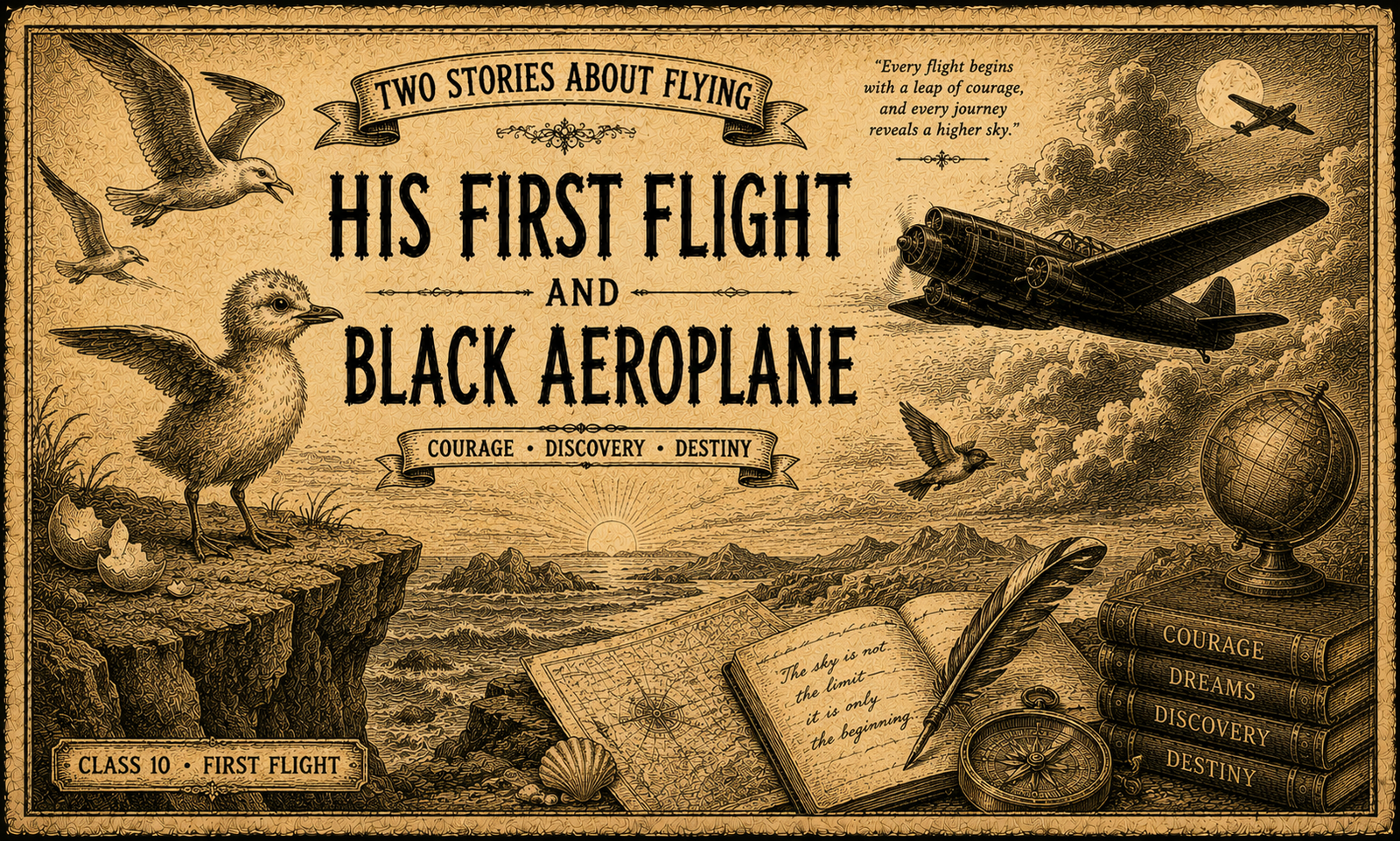
The chapter “Two Stories about Flying” presents two inspiring stories that explore the themes of courage, self-confidence, hope, and determination. Although the stories differ in setting and characters, both highlight how fear can be overcome through perseverance and faith.
The first story, “His First Flight” by Liam O’Flaherty, narrates the journey of a young seagull who is afraid to take his first flight. Through the seagull’s struggle, the story teaches that fear is a natural emotion, but it should never prevent us from achieving our goals. Confidence develops only when we dare to face challenges.
The second story, “The Black Aeroplane” by Frederick Forsyth, is a suspenseful tale about a pilot who encounters a violent storm while flying home. Just when all hope seems lost, a mysterious black aeroplane appears and guides him safely to an airport. The story explores the power of hope, faith, and the unexplained mysteries of life.
Together, these two stories convey a valuable message: fear can be conquered through courage, and hope often emerges in the darkest moments. They encourage readers to trust their abilities, remain determined in difficult situations, and believe that challenges can lead to personal growth and success.
His First Flight by Liam O’Flaherty
Summary:
Paragraph 1: The Young Seagull’s Fear
The story begins with a young seagull sitting alone on a narrow ledge of a cliff. His two brothers and sister have already learned to fly and have left the nest, but he remains behind because he is terrified of flying. Whenever he tries to move towards the edge and flap his wings, he becomes frightened by the vast sea stretching far below. He believes that his wings are too weak to support him and fears that he will fall into the sea. Even though his younger siblings successfully take their first flight, he cannot gather the courage to jump. His parents scold him and threaten to leave him hungry if he does not learn to fly, but fear completely overpowers him.
Paragraph 2: Hunger and Loneliness
Twenty-four hours pass, and no one comes to feed or comfort the young seagull. He watches his family flying gracefully, learning to skim over the sea and dive for fish. He even sees his elder brother catch his first fish while his parents proudly encourage him. The entire family ignores the young seagull and mocks him for his cowardice. As the hot sun rises higher in the sky, he grows weaker with hunger because he has not eaten since the previous evening. Feeling lonely and neglected, he pretends to sleep, hoping someone will notice him, but no one pays attention.
Paragraph 3: The Mother’s Clever Plan
While observing his family, the young seagull notices his mother tearing pieces of fresh fish. The sight of the food makes him desperately hungry. He cries loudly and repeatedly begs her to bring him something to eat. At first, she ignores him and even mocks his cries. Then she picks up a piece of fish and begins flying towards him. The young seagull becomes excited and leans forward eagerly, believing that she will feed him. However, just as she reaches him, she stops in mid-air with the fish just beyond his reach. Unable to control his hunger any longer, the young seagull dives towards the food without thinking about his fear.
Paragraph 4: The First Flight
As soon as he jumps, the young seagull feels terrified and believes he is falling to his death. However, within moments, his wings spread naturally. The wind lifts him, and he discovers that his wings are strong enough to carry him. He begins gliding smoothly through the air instead of falling. His fear disappears and is replaced by excitement and confidence. He flaps his wings joyfully, soars higher, and follows his family. His parents and siblings fly around him, celebrating his success. The young seagull quickly learns to dive, soar, and turn in the air, completely forgetting his earlier fear.
Paragraph 5: Success and Celebration
The young seagull flies over the sea and notices his family waiting for him on the water. They call out to encourage him to land. At first, he is frightened because he thinks he will sink into the sea. His feet touch the water, and he struggles briefly, but soon he realizes that he is floating safely. His family surrounds him happily, praises him, and offers him pieces of fish as a reward. The young seagull has finally conquered his fear and completed his first successful flight, marking the beginning of his independent life.
Word Meaning:
| Word | Meaning |
|---|---|
| Ledge | A narrow flat shelf or projection on the side of a cliff or wall. |
| Brink | The edge of a steep place or cliff. |
| Plunge | To dive or fall suddenly into something. |
| Cower | To shrink back or crouch in fear. |
| Upbraid | To scold or criticise severely. |
| Threaten | To warn someone of possible punishment or harm. |
| Pretend | To act as if something is true when it is not. |
| Herring | A small silver-coloured sea fish. |
| Devour | To eat something quickly and eagerly. |
| Scraps | Small leftover pieces of food. |
| Mackerel | A type of sea fish. |
| Beckon | To signal someone to come nearer by waving. |
| Shrilly | In a high-pitched, piercing voice. |
| Maddened | Made extremely angry, excited, or desperate. |
| Utter | To speak or express something. |
| Desperate | Feeling hopeless or in urgent need. |
| Motionless | Completely still; without movement. |
| Soar | To fly or rise high in the air. |
| Flap | To move wings up and down while flying. |
| Skim | To move lightly over the surface of water. |
| Swoop | To fly rapidly downward through the air. |
| Curveting | Moving or flying gracefully with quick turns. |
| Exhausted | Extremely tired. |
| Monstrous | Very large or enormous. |
| Reproachfully | In a way that expresses disappointment or disapproval. |
| Plaintively | In a sad or mournful manner. |
| Derisively | In a mocking or insulting manner. |
| Hover | To remain floating in one place in the air. |
| Halted | Stopped moving. |
| Hysterical | Extremely emotional or out of control. |
| Vast | Very large or immense. |
| Seashore | The land along the edge of the sea. |
| Precipice | A very steep cliff. |
| Whet | To sharpen or stimulate (especially appetite). |
| Triumph | A great victory or success. |
| Instinct | A natural ability or behaviour without learning. |
| Rejoice | To feel or express great happiness. |
| Confidence | Belief in one’s own abilities. |
| Independence | The ability to act or live without depending on others. |
| Phrase | Meaning |
|---|---|
| Take the plunge | To do something difficult or risky after hesitation. |
| Lose heart | To become discouraged. |
| At the brink of | At the edge of or very close to something. |
| Cry for food | To beg desperately for something to eat. |
| Make the first flight | To attempt something for the first time. |
| Overcome fear | To conquer one’s fear through courage. |
| Spread one’s wings | To become independent or start doing things confidently. |
| Take courage | To become brave enough to act. |
Textual Exercise Solutions
Thinking About The Text:
- Why was the young seagull afraid to fly? Do you think all young birds are afraid to make their first flight, or are some birds more timid than others? Do you think a human baby also finds it a challenge to take its first steps?
Ans: The young seagull was afraid to fly because he lacked confidence in his wings. Looking down at the vast sea below, he believed that his wings would not support him and that he would fall to his death. This fear prevented him from taking his first flight, even though his younger brothers and sister had already learnt to fly successfully.
Not all young birds are equally afraid of their first flight. Some birds are naturally more confident and adventurous, while others are timid and hesitant. Their courage varies according to their individual temperament.
Similarly, a human baby also finds it difficult to take its first steps. A baby often falls several times before learning to walk. With regular practice, encouragement, and determination, the baby gradually gains confidence and learns to walk independently. Thus, both the young seagull and a human baby must overcome fear before becoming independent.
- “The sight of the food maddened him.” What does this suggest? What compelled the young seagull to finally fly?
Ans: The statement “The sight of the food maddened him” suggests that the young seagull was suffering from intense hunger. He had not eaten since the previous evening and had become weak and desperate. His hunger was so severe that it overpowered his fear of flying.
His mother cleverly used his hunger to encourage him. She flew towards him with a piece of fish but stopped just beyond his reach. In an attempt to snatch the fish, the young seagull instinctively jumped forward. As he leapt into the air, his wings spread naturally, and he discovered that he could fly. Therefore, his unbearable hunger and his mother’s intelligent strategy finally compelled him to take his first flight.
- “They were beckoning to him, calling shrilly.” Why did the seagull’s father and mother threaten him and cajole him to fly?
Ans: The young seagull’s parents knew that flying was an essential skill for survival. Unless he learnt to fly, he would never be able to search for food, escape danger, or live independently. They also realised that his fear was preventing him from discovering his true ability.
For this reason, they first threatened to leave him hungry and later encouraged him with repeated calls. Finally, the mother cleverly tempted him with a piece of fish so that hunger would force him to leap into the air. Their actions were not cruel but loving and practical, as they wanted their son to become confident and self-reliant.
- Have you ever had a similar experience, where your parents encouraged you to do something that you were too scared to try? Discuss this in pairs or groups.
Ans: Yes, I have had a similar experience. When I was learning to ride a bicycle, I was afraid that I would lose my balance and fall. My parents continuously encouraged me and assured me that falling was a part of learning. Although I fell several times, they motivated me to keep trying. Eventually, I learnt to ride confidently. This experience taught me that fear can be overcome through courage, determination, and the support of our loved ones.
- In the case of a bird flying, it seems a natural act, and a foregone conclusion that it should succeed. In the examples you have given in answer to the previous question, was your success guaranteed, or was it important for you to try, regardless of a possibility of failure?
Ans: Unlike a bird, whose ability to fly is a natural instinct, human success is never guaranteed. There is always the possibility of failure while learning a new skill. However, making an honest effort is more important than worrying about the result. Every attempt provides valuable experience and increases confidence. Even failure teaches important lessons and helps us improve. Therefore, it is essential to keep trying despite the possibility of failure, because perseverance ultimately leads to success.
Writings
Write a short composition on your initial attempts at learning a skill. You could describe the challenges of learning to ride a bicycle or learning to swim. Make it as humorous as possible.
My First Bicycle Ride
Learning to ride a bicycle was one of the funniest experiences of my childhood. On the first day, I proudly climbed onto the bicycle, believing that I would become an expert within minutes. Unfortunately, the bicycle had other plans. Instead of moving straight, it seemed determined to visit every bush, wall, and tree in the neighbourhood.
My father patiently held the seat while I pedalled confidently. The moment he quietly let go, I realised that I was riding alone. Instead of celebrating, I panicked and forgot everything I had learnt. Within seconds, I landed safely in a patch of soft grass. My friends laughed so loudly that even I could not stop smiling.
For several days, my knees collected scratches like trophies, and I became quite familiar with the ground. However, I refused to give up. Gradually, I learnt to balance, pedal, and steer at the same time. One day, I rode across the park without falling even once. I felt as if I had won an Olympic gold medal.
Today, I ride confidently wherever I go. Whenever I remember my first bicycle ride, I laugh at my dramatic falls and realise that every expert was once a beginner.
Black Aeroplane by Frederick Forsyth
Summary:
Paragraph 1 (A Peaceful Beginning)
The narrator, an experienced pilot, is flying his old Dakota aeroplane from France to England on a calm and beautiful night. The moon shines brightly, stars fill the sky, and there are no clouds. He enjoys the peaceful journey and eagerly looks forward to reaching home in time for breakfast with his family. After contacting Paris Control, he changes his direction slightly according to their instructions and continues flying confidently. Everything appears normal and safe.
Paragraph 2 (The Dangerous Decision)
While flying, the pilot suddenly notices enormous storm clouds ahead. They resemble huge black mountains blocking his path. He realises that he cannot fly over the clouds because they are too high, and he does not have enough fuel to fly around them either. Although he knows that returning to Paris would be the safest option, his desire to reach home makes him ignore the danger. He decides to take the risk and flies directly into the storm. This decision sets the stage for the suspenseful events that follow.
Paragraph 3 (Trapped Inside the Storm)
As soon as the Dakota enters the storm clouds, everything becomes completely dark. The aircraft shakes violently because of the strong winds. Soon, the pilot discovers that his compass has stopped working. One by one, all the instruments fail, and even the radio becomes useless. He loses communication with Paris Control and has no idea where he is. Completely surrounded by darkness, with no navigation equipment and little fuel left, he becomes frightened and realises that he is lost.
Paragraph 4 (The Mysterious Guide)
At the height of his fear, the narrator suddenly notices another aeroplane flying close beside him. It has no lights, but he can clearly see its pilot. The mysterious pilot waves at him and signals him to follow. Believing that the stranger knows the way, the narrator obediently follows the black aeroplane through the storm. For almost thirty minutes, the unknown aircraft continues leading him while the fuel in the Dakota keeps decreasing. Although worried about running out of fuel, the narrator trusts the mysterious pilot completely.
Paragraph 5 (The Mystery Remains Unsolved)
Finally, the mysterious aeroplane begins to descend, and the narrator follows it. Soon, he emerges from the storm and sees the bright runway lights of an airport. He lands safely with only a few minutes of fuel remaining. When he turns around to thank the unknown pilot, the black aeroplane has disappeared. Inside the control tower, a woman tells him that no other aircraft was flying during the storm and that the radar had shown only his Dakota. The story ends with an unsolved mystery, leaving readers wondering whether the mysterious pilot was an angel, a supernatural helper, or simply a product of the narrator’s imagination.
Word Meanings:
| Word | Meaning |
|---|---|
| Aeroplane | An aircraft that flies using wings and engines. |
| Dakota | A type of twin-engine aircraft used for transport. |
| Control Tower | A building at an airport from which air traffic is directed. |
| Runway | A long, paved strip where aircraft take off and land. |
| Storm | A violent weather condition with strong winds, rain, thunder, or lightning. |
| Clouds | Masses of tiny water droplets or ice crystals in the sky. |
| Horizon | The line where the earth and the sky appear to meet. |
| Compass | An instrument that shows direction. |
| Radio | A device used for wireless communication. |
| Navigation | The process of planning and directing the course of a journey. |
| Fuel | The substance that provides power to an aircraft. |
| Engine | The machine that powers an aircraft. |
| Pilot | A person who flies an aircraft. |
| Risk | The possibility of danger or loss. |
| Approach | To move nearer to something. |
| Frightened | Feeling afraid or scared. |
| Strange | Unusual or unfamiliar. |
| Mysterious | Difficult or impossible to explain. |
| Signal | A gesture or action used to convey information. |
| Wave | To move the hand as a sign or signal. |
| Flash | A sudden burst of bright light. |
| Visible | Able to be seen. |
| Disappear | To go out of sight. |
| Journey | The act of travelling from one place to another. |
| Safely | Without harm or danger. |
| Relieved | Feeling happy because danger or worry has ended. |
| Emergency | A sudden dangerous situation requiring immediate action. |
| Helpless | Unable to do anything to improve a situation. |
| Violently | With great force or intensity. |
| Swirl | To move in a twisting or spinning motion. |
| Blackness | Complete darkness. |
| Astonished | Greatly surprised. |
| Strangely | In an unusual or unexpected manner. |
| Enough | As much as is needed. |
| Radar | A system that detects the position and movement of aircraft or other objects using radio waves. |
| Instructions | Directions or orders explaining what to do. |
| Mile | A unit of distance equal to about 1.6 kilometres. |
| Airport | A place where aircraft take off and land. |
| Storm Clouds | Thick, dark clouds that produce storms. |
| Run Out (of fuel) | To have no fuel remaining. |
| Guide | To lead or direct someone safely. |
| Wonder | To think about something with curiosity or surprise. |
| Phrase | Meaning |
|---|---|
| Take the risk | To do something despite knowing it may be dangerous. |
| Run out of fuel | To use up all the fuel. |
| Lose one’s way | To become lost or uncertain of the direction. |
| Fly through the storm | To continue flying despite dangerous weather. |
| Guide to safety | To lead someone out of danger. |
| At the last moment | Just before it is too late. |
| Make a safe landing | To land an aircraft without any accident. |
| Disappear into the clouds | To go out of sight among the clouds. |
| Look strangely at someone | To look at someone with surprise or disbelief. |
| Leave someone puzzled | To make someone confused or unable to understand. |
Textual Exercise Solutions
Thinking About Text:
- “I’ll take the risk.” What is the risk? Why does the narrator take it?
Ans: The risk is flying the old Dakota aeroplane directly through a dangerous storm instead of returning to Paris or taking a longer route around it. The narrator is fully aware that storm clouds can cause serious problems during a flight. However, he does not have sufficient fuel to fly around the storm, and he is eager to reach England in time for breakfast with his family.
His strong desire to return home outweighs his fear of the storm. Confident in his flying skills, he decides to continue his journey despite the obvious danger. This decision reflects both his determination and his willingness to take a calculated risk.
- Describe the narrator’s experience as he flew the aeroplane into the storm.
Ans: As soon as the narrator entered the storm clouds, everything around him became completely dark. The Dakota was violently tossed about by strong winds, making it difficult to control. He could not see anything outside the aircraft.
Soon, his compass stopped working and kept spinning aimlessly. One after another, all the flight instruments failed. His radio also became useless, leaving him unable to communicate with Paris Control. With no compass, no radio, no visibility, and very little fuel remaining, he realised that he was completely lost.
At that frightening moment, he suddenly noticed another black aeroplane flying nearby. The mysterious pilot signalled him to follow. Trusting the stranger, the narrator followed the aircraft through the storm until he safely reached an airport.
- Why does the narrator say, “I landed and was not sorry to walk away from the old Dakota…”?
Ans: The narrator makes this statement because he has just survived a terrifying experience. During the flight, his old Dakota aeroplane encountered a violent storm, lost all navigation instruments, and almost ran out of fuel. He genuinely believed that he might never reach safety.
After landing safely, he felt an overwhelming sense of relief and gratitude. Walking away from the aircraft symbolised the end of a frightening ordeal. Therefore, he was not sorry to leave the old Dakota behind because it reminded him of the danger he had narrowly escaped.
- What made the woman in the control centre look at the narrator strangely?
Ans: The woman in the control centre looked at the narrator strangely because he asked her about the mysterious black aeroplane and its pilot. The narrator wished to thank the unknown pilot who had guided him safely through the storm.
However, according to the radar records, no other aircraft had been flying that night. The radar had detected only the narrator’s Dakota aeroplane. Since there was no evidence of another plane, the woman was surprised and puzzled by his question.
- Who do you think helped the narrator to reach safely? Discuss this among yourselves and give reasons for your answer.
Ans: The identity of the mysterious pilot is left unexplained by the author, allowing readers to form their own opinions. In my opinion, the black aeroplane symbolises a supernatural force, a guardian angel, or divine intervention that appeared during the narrator’s moment of greatest danger.
Several details support this interpretation. No other aircraft appeared on the radar, the mysterious plane had no lights, and it disappeared immediately after guiding the narrator to safety. These unusual circumstances suggest that the helper was not an ordinary pilot. The story therefore emphasises that hope and unexpected help may appear even in the darkest moments of life.
Thinking About Language
I. Study the sentences given below.
Now, try to guess the meanings of the word ‘black’ in the sentences given below. Check the meanings in the dictionary and find out whether you have guessed right.
- Go and have a bath; your hands and face are absolutely black.
Answer: Here, black means very dirty or covered with dirt or soot.
- The taxi-driver gave Ratan a black look as he crossed the road when the traffic light was green.
Answer: Here, black look means an angry, hostile, or disapproving look.
- The bombardment of Hiroshima is one of the blackest crimes against humanity.
Answer: Here, blackest means extremely evil, cruel, or inhuman.
- Very few people enjoy Harold Pinter’s black comedy.
Answer: Here, black comedy means a form of humour that deals with serious, tragic, or unpleasant subjects in a humorous or ironic way.
- Sometimes shopkeepers store essential goods to create false scarcity and then sell these in black.
Answer: Here, in black means illegally at a higher price in the black market.
- Villagers had beaten the criminal black and blue.
Answer: Here, black and blue means badly bruised due to severe beating.
II. Match the phrases given under Column A with their meanings given under Column B.
| Column A | Column B |
|---|---|
| 1. Fly a flag | Display a flag on a long pole |
| 2. Fly into rage | Become suddenly very angry |
| 3. Fly along | Move quickly or suddenly |
| 4. Fly high | Be successful |
| 5. Fly the coop | Escape from a place |
III. We know that the word ‘fly’ (of birds/insects) means to move through air using wings. Tick the words which have the same or nearly the same meaning.
Correct Answers:
✔ Swoop
✔ Flit
✔ Flutter
✔ Ascend
✔ Float
✔ Dart
✔ Hover
✔ Glide
✔ Descend
✔ Soar
✔ Sail
✔ Flap
Words that do not have the same meaning: Paddle, Ride, Sink, Shoot, Spring, Stay, Fall.
Writings
Have you ever been alone or away from home during a thunderstorm? Narrate your experience in a paragraph.
A Memorable Experience During a Thunderstorm
Once, I was alone at home when a severe thunderstorm suddenly began. Within a few minutes, dark clouds covered the sky, and strong winds started blowing. Loud claps of thunder echoed across the neighbourhood, while flashes of lightning lit up the sky. Soon, the electricity went out, making the house dark and silent. At first, I felt frightened because I had never experienced such a powerful storm alone. I stayed indoors, closed all the windows, and kept myself calm by reading a book. After some time, the rain became lighter, and the storm gradually passed. When my family returned home safely, I felt greatly relieved. The experience taught me the importance of remaining calm and sensible during difficult situations.


Leave a Reply